

Neglect, dislike, or whatever you want to call it, investors in the energy sector are completely misreading the situation unfolding in Colombia. Following Abelardo de la Espriella’s victory on June 21, investors have seemingly responded to Colombian oil producers with a “meh”.
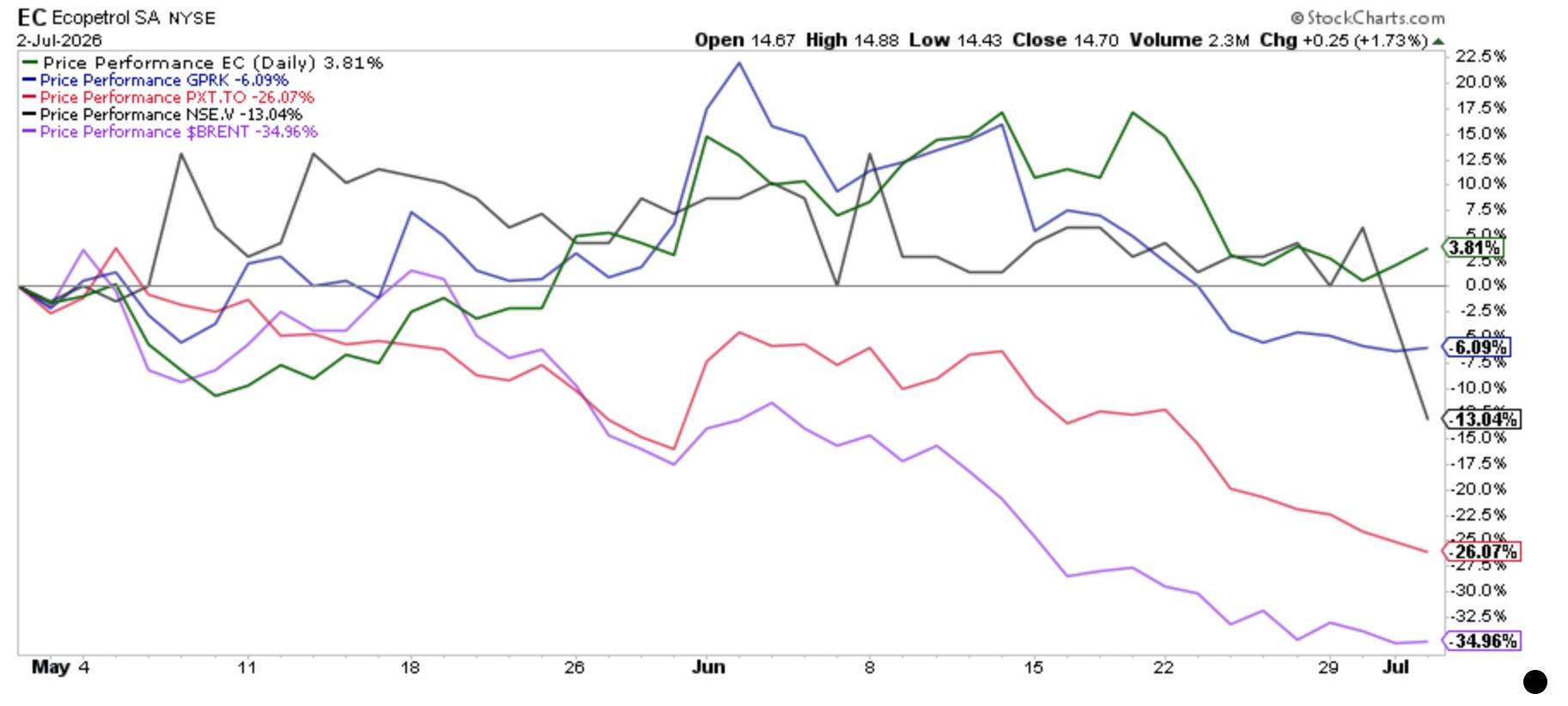
It doesn’t help that, since the start of Espriella’s rise in the polls, Brent has tumbled by ~35%, dampening enthusiasm for energy stocks. However, the investment community should pay closer attention to all the producers in the country, namely, the potential for more deals and exploration.
In particular, something very important came out today from Espriella’s Vice President, José Manuel Restrepo, in an interview with El Tiempo and Portafolio. This was his comment on Ecopetrol and on the state of Colombia’s oil and gas industry. I highlighted the most important part:
Regarding the issue of Ecopetrol, the vice president-elect pointed out that “it is very unfortunate. He has attacked it structurally and strategically (the current president, Petro) by preventing it from signing new gas and oil exploration contracts, by preventing unconventional exploitation in Colombia or abroad. He has attacked it operationally and financially, to the point that today, exploitation is more costly than it was 2 years ago. He has also attacked it in terms of corporate governance by intervening in decisions such as the one Ecopetrol had ready, and they threw it back after nearly 2 years of decision-making. And he has attacked it in reputational terms by keeping the current president in place.”
With that said, Restrepo stated that what needs to be done at Ecopetrol “from day 1 of our government is to call the assembly so that the assembly changes the board and the board of directors changes immediately. That is an immediate decision. I have no doubt that the assembly will be called. The assembly must change the board of directors and the board of directors must change the presidency of Ecopetrol as quickly as possible. Certain terms must be respected.”
The context is important to understand here because Colombia is the 5th largest oil producer in South America, and Ecopetrol, the national oil company, handles oil and gas contracts with independent oil producers. Every deal that gets signed needs to be vetted by Ecopetrol to some extent and by the Colombian government, which creates tedious delays and bureaucratic hurdles.
Under Petro (the left-wing current president), oil and gas exploration took a severe hit as he banned new E&P contract rounds and shortened long-term contract terms. In addition, Colombia’s gas reserves began to fall, making it more import-dependent, and its oil reserves now sit at just under 8 years at the current production of 734k boe/d.
This is not a situation you want to be in when you are an oil exporter. Colombia, under the left, was going to see oil and gas production fall in the coming years if capex didn’t increase meaningfully.
Political Godsend
It’s important to first understand the oil and gas deal structure in Colombia to give you a flavor of what to expect. Historically speaking, Ecopetrol has relied on outside capital to fund growth capex and increase total production. Deals are usually structured as follows:
50/50 split in production sharing, the operator partner gets 50% of the production.
Capex is usually weighed on the operator partner first, and then split 50/50 later, or in some cases, it is just paid for by the operator partner.
Royalty is charged on the 50% production piece of the operator, so Colombia benefits from 1) the capex spent by the operator and 2) the royalty payment made.
From Ecopetrol’s standpoint, which is majority-owned by the Colombian government (88.49%), the capex spend gives it optionality for production upside and exploration potential. The royalty payment maximizes cash flow, and the even split in production gives the operator every incentive to increase production as much as possible.
It’s a win-win deal.
But under Petro, Ecopetrol suffered because 1) he banned exploration and 2) he vilified oil and gas and pivoted the economy towards renewables.
Now that he’s gone, Ecopetrol will embark on a new era of exploration and deal-making. There are 4 years of pent-up demand for deals that have been sitting in the back office, cluttered by bureaucracy. For the sake of due diligence, we have hired on-the-ground political consultants to inform us about the labyrinth we need to navigate in such a hostile political environment, and let me just say that it is more torturous than poking your own eyes with needles.
Under Espriella, his campaign was pro-hydrocarbons. He wants to restart oil and gas exploration, something Petro banned. He wants to issue new contracts, allow responsible fracking, offshore Caribbean oil and gas, and push Ecopetrol’s reserves higher. He stated in his campaign that he wants to push Colombian oil production from ~734k boe/d to 1.35 million boe/d. That’s not possible without the support of other operators, as I explained above.
What does that mean for oil producers?
Parex Resources (PXT.TO) is now the largest independent oil producer in Colombia. It has become the behemoth primarily through deals with Ecopetrol and exploration contracts through the previous administration. Espriella’s presidency will put Parex squarely in the center as one of the key producers to take advantage of what’s to come.
Geopark (GPRK) is also extremely well-positioned to capitalize on new deals. One key issue for both Parex and Geopark was that during the Petro administration, the lack of new exploratory contracts made it very difficult to expand oil reserves. Following the production sale by Fronterra Energy, formerly known as Pacific Rubiales (more on this later), Parex emerged as the largest independent oil producer, forcing Geopark into Argentina and Venezuela.
I suspect Geopark will make an aggressive move back into Colombia now that the administration is favorable towards signing new oil and gas contracts.
What about Ecopetrol?
Well, I am reluctant to give it my blessing here, considering that the inner workings of a national oil company are inherently slow and inefficient. I suspect Ecopetrol will need to rely more on independent oil producers to execute rather than executing itself. In addition, as Jon covered in January, the valuation on Ecopetrol shares is not attractive relative to the others.
Now, for readers, you will have noticed a trade alert today that I bought more shares of New Stratus Energy (NSE.V). On paper, NSE does not have producing assets in Colombia yet, but the company announced in its year-end reports that the Colombia deal was expected to close towards the end of May. But from what I understand, political events made it difficult for a national oil company to finish deals.
From my understanding, the runoff presidential election results, which ended on May 26, saw Espriella, a right-wing candidate, surge to the top. Iván Cepeda, the candidate supported by Petro and favored going into the election, quickly fell behind. Because of this political backdrop, it is difficult for national oil companies to announce any changes to their existing operations for fear of political backlash, especially if the right-wing candidate wins.
Following the election results on June 21, where Espriella won, the president-elect immediately demanded that Ecopetrol’s board and CEO be replaced as his first decree. This meant that anything the national oil company does from now to August 7th will be heavily scrutinized, even if the existing due diligence was already in place.
But given everything I wrote here about how favorable Espriella will be to the oil and gas industry, I believe today’s sell-off presented an excellent opportunity to add to our position. The comments from the Vice President today about how the first order of business is to call for an extraordinary shareholder meeting, followed by execution of oil and gas contracts that have been months/years in the making, is the most bullish signal one needs to understand the situation that we are in.
And for NSE specifically, JF Arata, CEO of the NSE, is well-positioned to capitalize on the upcoming deal boom in Colombia. He was a co-founder of Pacific Rubiales, which was at one point the largest independent oil producer in Colombia. JF was also responsible for developing the Rubiales oil field, the largest heavy-crude deposit in Colombia. The operational team that was formerly at Pacific Rubiales joined JF when they started NSE.
This is why, from an execution standpoint, I believe the team can execute, but we just need to survive the myriad of political labyrinths required to land deals in South America.
I hope this explains my logic and my bullishness on Colombian oil producers.
Conclusion
I believe investors are still misreading the sentiment in Colombia largely due to the fact that it is 1) underfollowed, 2) unloved, and 3) in the energy sector. The recent sell-off in oil prices did not help, but I think this seismic political change will give the Colombian energy sector a major boost.
We plan to allocate to both Geopark and Parex tomorrow, in addition to our exposure in NSE. I think this is where the undervaluation is if you are looking for upstream oil producers.
Analyst’s Disclosure: I/we have a beneficial long position in the shares of NSE.V, PXT.TO either through stock ownership, options, or other derivatives.