


By: Jon Costello
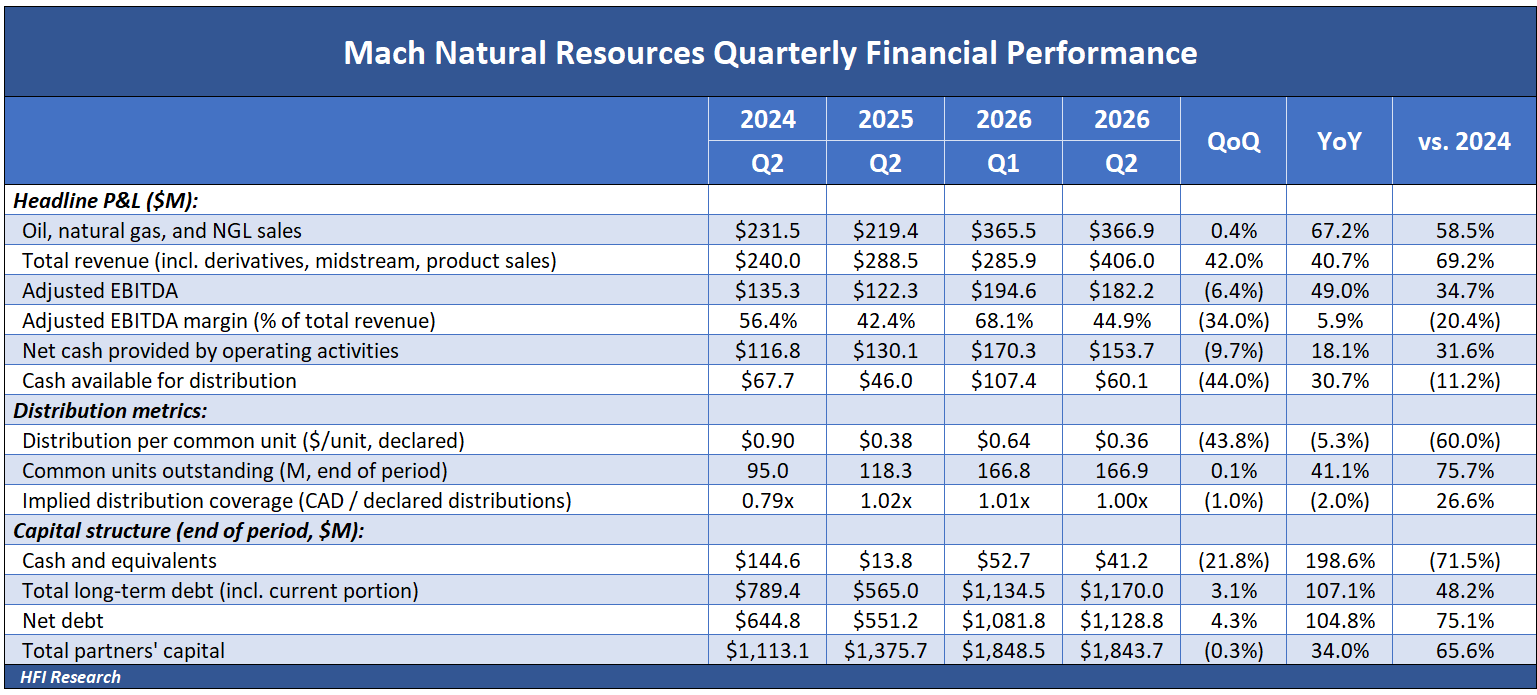
Mach Natural Resources’ (MNR) units have been under pressure since early August for two very different reasons. The first was fundamental, with the second quarter coming in weaker than I expected and Mach cut its quarterly distribution to $0.36 from $0.64.
The second was technical. On September 15, Kayne Anderson began marketing 8 million units at a discount to the prior close.
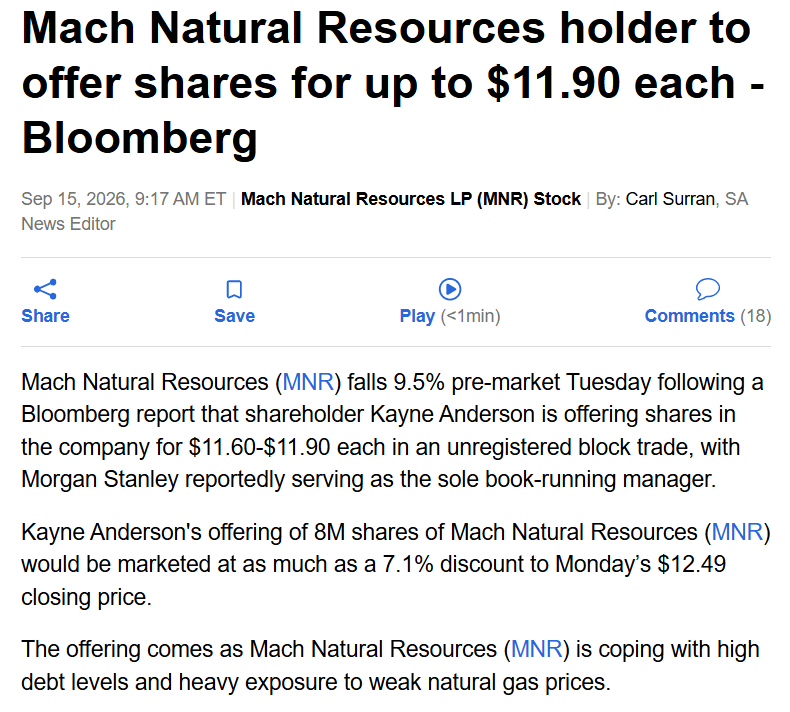
Source: Seeking Alpha, Sept. 15, 2026.
On the first reason for the unit price weakness, second-quarter results do raise legitimate questions about Mach’s reinvestment needs and balance sheet. On the second, a large financial holder deciding to sell did not change my view of what the underlying assets are worth.
Kayne Anderson manages the private investment fund that owns Sabinal Energy Operating, which received Mach units when Mach acquired Sabinal. After an April secondary offering, Sabinal reported holding about 15.5 million units. The September block therefore represented roughly half of that position. This was a financial holder reducing a large stake, not management selling its own units.
A seller accepting a discount to move that many units tells us something about its desire for liquidity. It doesn’t convey information about what Mach’s assets are worth.
My Mach thesis has not changed. As such, I’ve used the weakness in the units to buy for the Plutus portfolio.
What I Got Wrong About Q2 Results
The table below shows a quarterly comparison of Mach’s financial results. The quarter-over-quarter results are most relevant for Mach investors, as both quarters included a full-quarter contribution from the Sabinal and IKAV assets.
The quarter was weaker than I expected because I was wrong about an important mechanism.
In my June article, I assumed higher oil prices would flow fairly more directly through to cash available for distribution. They did not. Cash available for distribution fell to $60.1 million from $107.4 million in the first quarter, while development costs rose to $96.6 million from $75.2 million.
That $21.4 million increase in development spending mechanically accounted for about 45% of the decline in cash available for distribution. Higher oil prices reached revenue, but much of the benefit stopped at development spending.
That doesn’t mean management made the wrong decision. It means I underestimated what the capital reallocation would do to near-term distributable cash.
The Oil Pivot Has Yet to Show Up in Production
Mach’s ability to move capital between commodities remains one of the things I like about the business. CEO Tom Ward said that after the Iran conflict began, Mach shifted from drilling entirely for natural gas toward oil-heavy drilling, reversing the pivot it made after the tariff shock in April 2025.
Mach restarted the Oswego drilling program in May. Management says those wells target roughly 160,000 barrels of oil for about $3.3 million to drill and complete.
The problem is that the production benefit had not arrived by quarter-end.
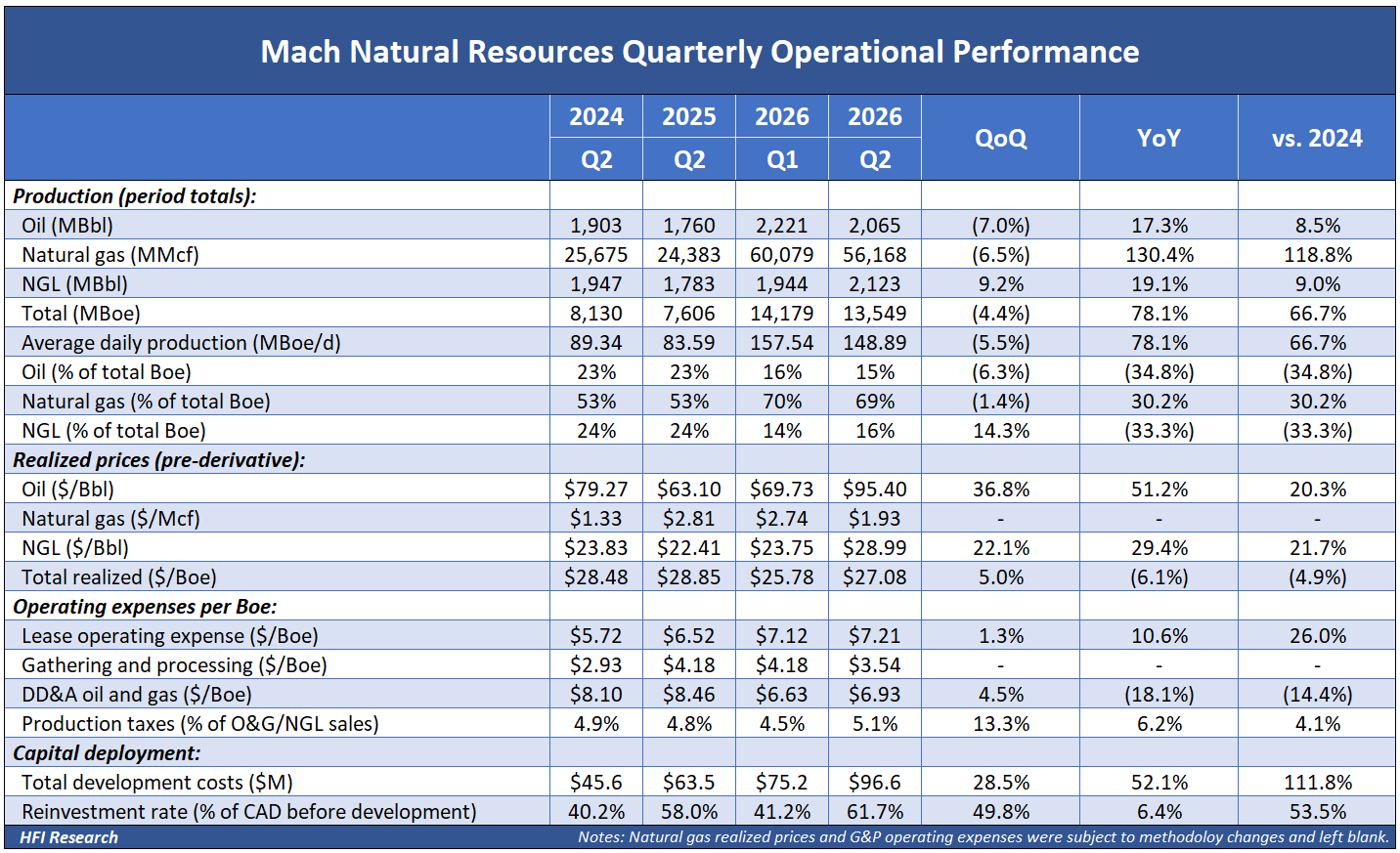
Total production declined 5.5% sequentially to 148.9 Mboe/d, while oil production fell about 8% to 22.7 MBbl/d. Mach also deferred completion of its Mancos gas wells until 2027 to stay within its annual reinvestment framework. The second quarter therefore reflected the cost of changing direction while base production continued to decline.
The revenue mix improved because realized oil prices rose to $95.40 per barrel. But the improvement came from price, not additional oil barrels.
Watching the Reinvestment Rate
Management says Mach can keep production roughly flat while reinvesting less than 50% of operating cash flow. That claim is central to the thesis because a low reinvestment requirement leaves more cash available for distributions.
Second-quarter results do not disprove it, as management describes 50% as an annual framework, not a quarterly ceiling. But development costs equaled 62.9% of operating cash flow, and production still declined.
First-half production averaged about 153.1 Mboe/d. The midpoint of full-year guidance implies roughly 144 Mboe/d during the second half.
This is now the operating question I care about most. If Mach consistently needs materially more capital than management suggests merely to hold production flat, the economics of the business may be worse than I have assumed. If the second quarter instead reflected the timing of deferred gas completions and the lag before the restarted Oswego program contributes, production should begin to stabilize.
The next several quarters should tell us which explanation is right.
What I Am Paying for the Assets
At $10.52, I think the valuation compensates me for these problems.
Using roughly 166.9 million units outstanding and quarter-end net debt of about $1.13 billion, Mach’s enterprise value at $10.52 is under $3.0 billion. That is slightly below the $3.09 billion PV-10 of proved reserves reported at year-end 2025 SEC pricing. PV-10 is not fair value, but it is a useful reference point.
At that price, the units also trade at roughly 4.3 times trailing twelve-month Adjusted EBITDA.
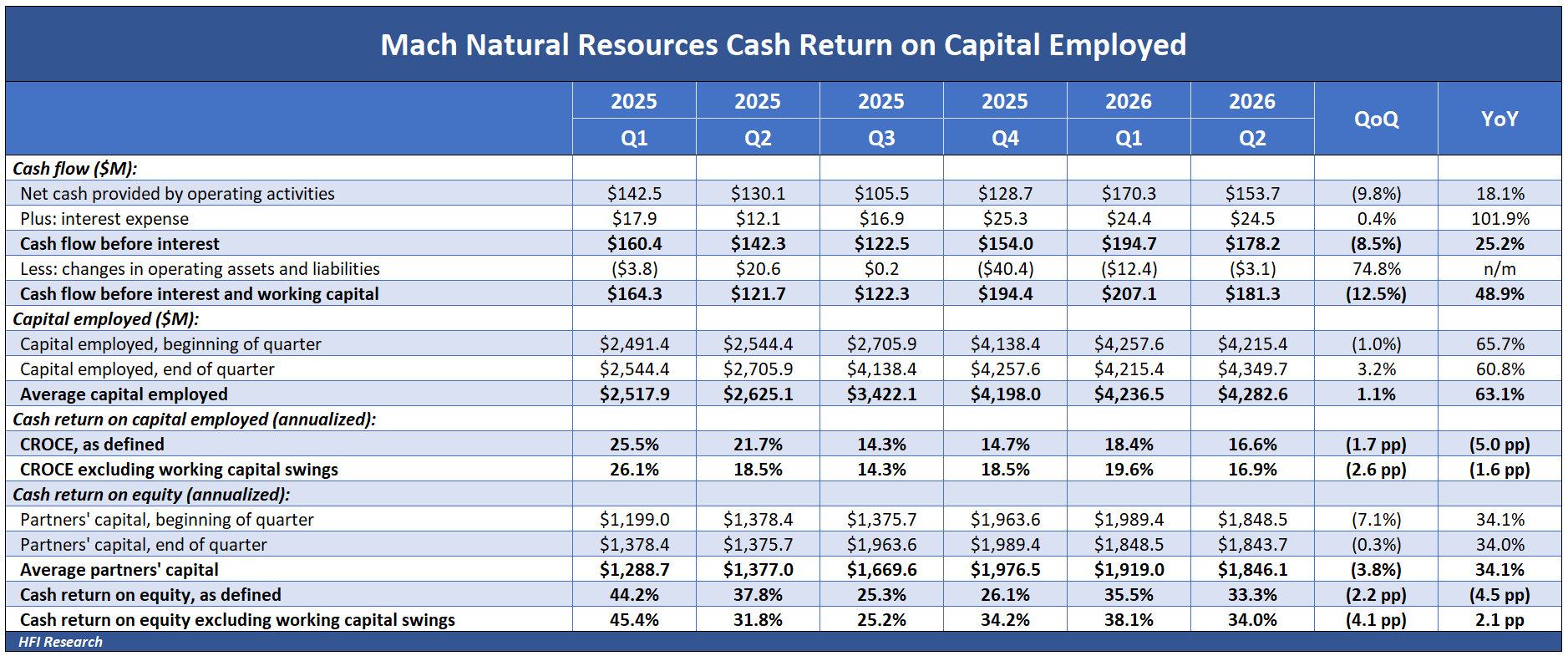
By my calculation, cash return on capital employed was 16.5% over the trailing twelve months and 8.6% after development spending. Development capital is consistently slightly lower than depreciation, reducing concern that under-spending is inflating the return.
Alignment remains meaningful. Tom Ward reported beneficial ownership of about 8.4% of the units in May, and he and affiliated entities purchased 153,256 units at $13.05 in April.
Mach also says all 23 acquisitions since 2018 have met its requirement of buying cash-flowing assets at a discount to PDP PV-10.
Management has not yet demonstrated the deleveraging it believes is important. Net debt was about $1.13 billion at quarter-end, or roughly 1.6x trailing Adjusted EBITDA by my calculation, versus Mach’s stated long-term target of 1.0x.
The Risks I Am Watching Most Closely
Weak natural gas prices remain the biggest commodity problem for all natural gas producers, including Mach. The company realized just $1.93 per Mcf in the second quarter.
A fixed-price sales contract inherited with the IKAV assets requires Mach to deliver 64.5 Bcf of natural gas in 2027 at $1.72 per MMBtu, roughly 29% of a 620 MMcf/d annualized production base. Higher gas prices will help Mach, but not every molecule will receive them.
Oil hedges also limit near-term upside. As of August 1, Mach had 797 MBbl of Q3 oil swapped at an average $65.41 per barrel, plus another 184 MBbl under collars with a $60 floor and a $78.52 ceiling. At roughly second-quarter production levels, a little more than half of Q3 oil volumes remain outside those positions.
Mach’s credit agreement requires the company to hedge at least 50% of projected PDP oil and gas production over the next twelve months and 25% over months thirteen through twenty-four. Against second-quarter production, its oil hedges cover roughly half of volumes and its gas hedges about one-fifth. So part of the hedge book reflects lender requirements, not simply management’s view of commodity prices. Given Mach’s leverage, that protection makes sense, but it also limits the upside to cash flow when commodity prices rise.
The more serious risk is dilution. Mach has a $100 million at-the-market equity program, with proceeds intended primarily to repay borrowings. Through June 30, it had issued only about 129,000 units, raising $1.7 million gross. If management begins issuing meaningful equity at prices materially below intrinsic value, I would view that as permanent dilution and a direct challenge to my thesis.
The distribution can also fall again. It is the residual after development spending, coverage was essentially 1.00x this quarter, and management has said it would cut the distribution before selling assets.
What I Am Watching Next
I need to see the company’s oil pivot begin to show up in production, development spending stabilize volumes without consuming an excessive share of cash flow, and leverage move toward management’s stated target.
At $10.52, I think the market is giving me more than enough compensation for the leverage, commodity exposure, and questions the second quarter raised.
That is why I bought more.
Link to HFIR Energy Income Portfolio on RunPlutus.
Analyst’s Disclosure: I/we have a beneficial long position in the shares of MNR either through stock ownership, options, or other derivatives.