

Editor’s Note: This article was first published to paid subscribers on August 3, 2026.
Ship-to-ship transfers, I am sure you have read something along those lines by now. Fujairah, UAE’s bypass hub for the Strait of Hormuz, has been responsible for these S2S (ship-to-ship) transfers, which have accounted for ~4 to ~5 million b/d of crude outflows.
Why is this important?
Pre-conflict, the Strait of Hormuz saw oil flows of ~20 million b/d.
Post-conflict, there are two bypasses:
Saudi’s east-to-west pipeline: 7 million b/d, but only ~4 million b/d of crude export capacity in Yanbu.
UAE’s Abu Dhabi pipeline: 1.8 million b/d.
At the start of the war, we saw both Saudi and the UAE quickly switch to bypass routes to circumvent the Strait of Hormuz.
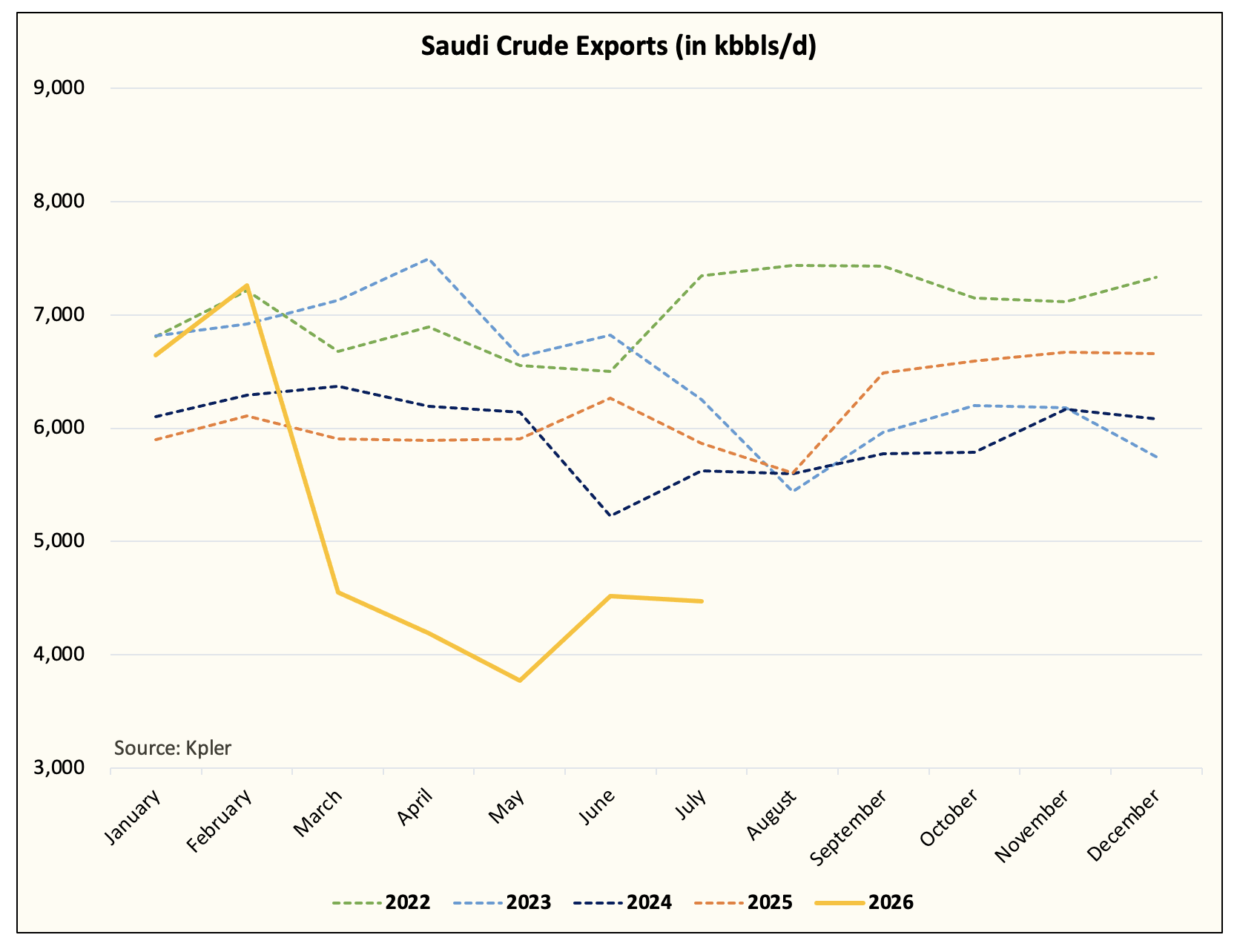
This was best reflected in the Saudi and UAE crude export figures.
Saudi
UAE
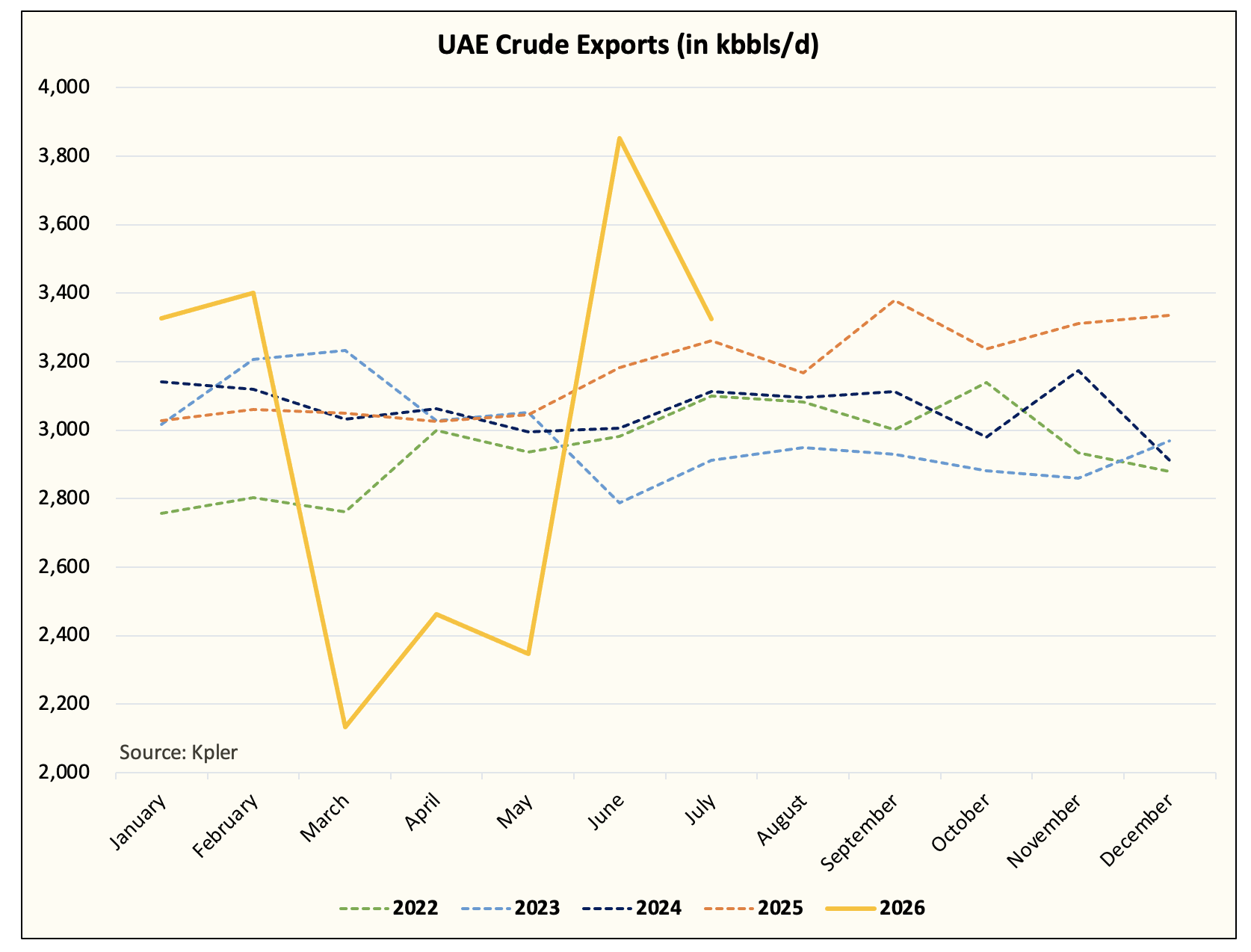
Now what you will notice is something starkly different in the charts above. Unlike the Saudis, which are still experiencing constrained export activities, UAE saw a massive surge in crude exports in June and the July export figures remain elevated.
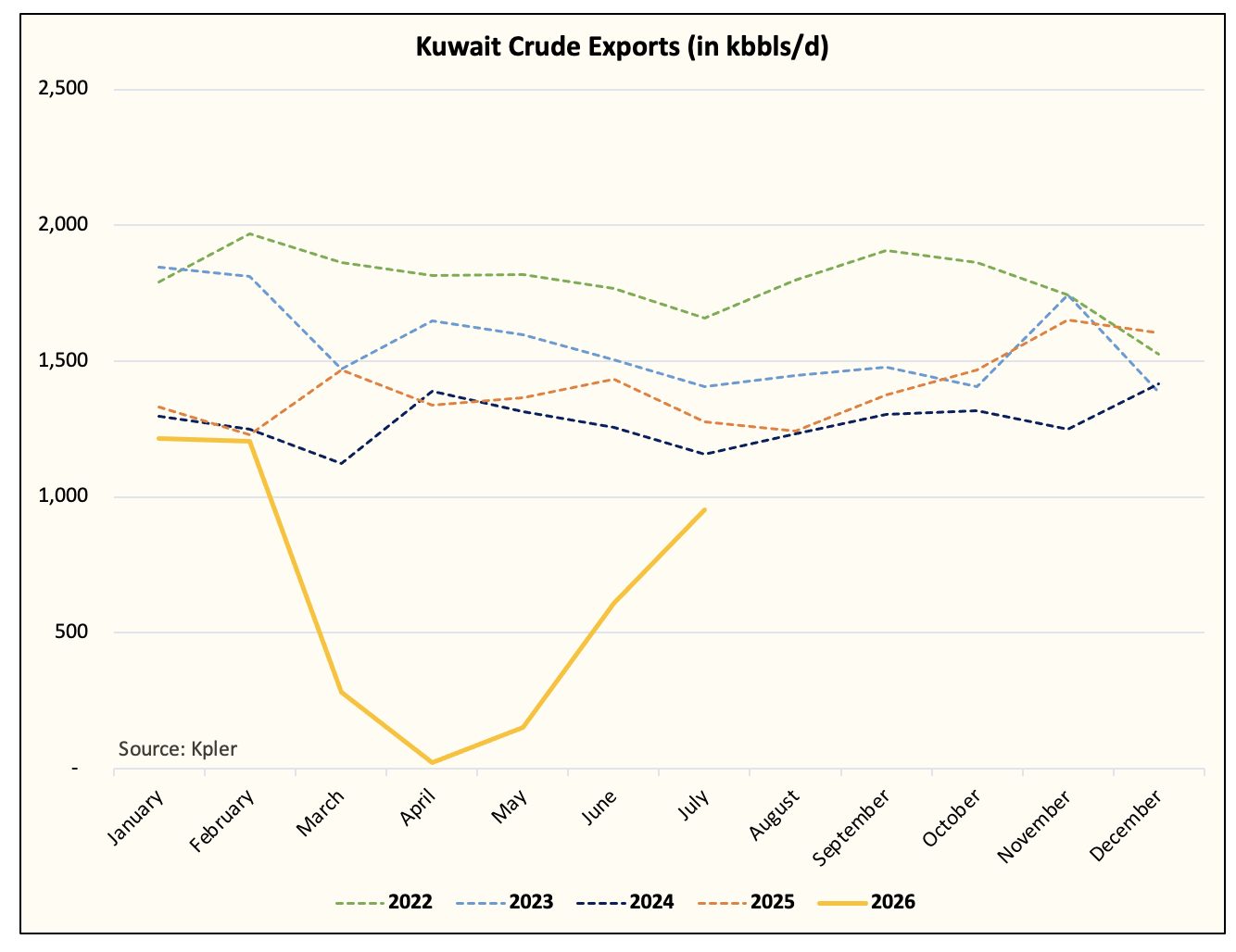
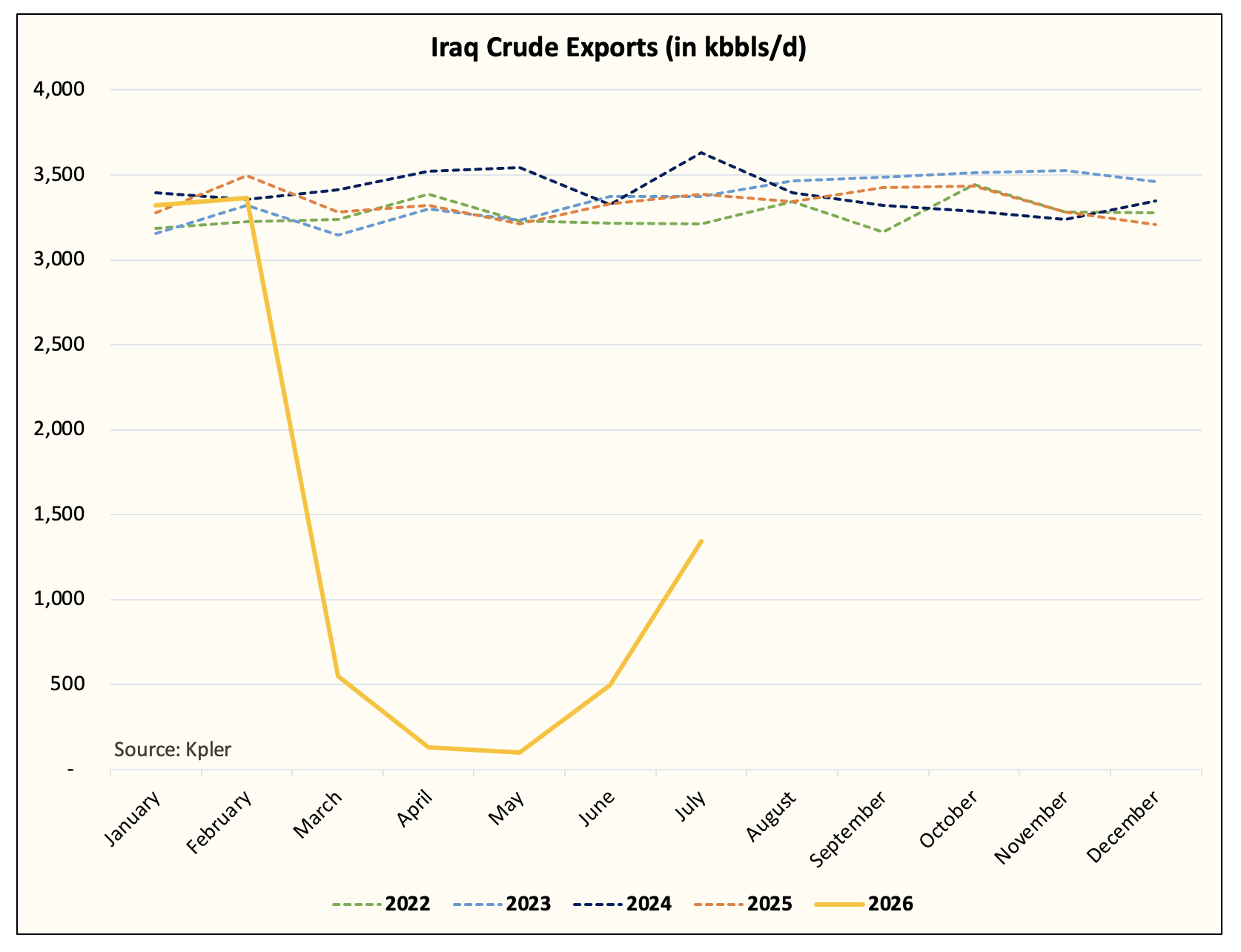
In addition, both Kuwait and Iraq crude exports did not return to zero in July despite renewed conflicts in the Strait.
Kuwait
Iraq
Why is that?
Because of the S2S through the Oman lane and Fujairah.
How much (in million b/d)?
Kuwait - 1
Iraq - 1.5
UAE - 1.2
Saudi - 0.5
Total: 4.2 million b/d
This lines up with the rough estimates from Kpler, Vortexa, and others who have tracked the data.
What’s the significance of this?
The Iran war is an all-or-nothing conflict because Iran’s very survival is dependent on the outcome of this war. From an escalation standpoint, the Strait of Hormuz issue is all-or-nothing. If Iran agrees to any temporary deal without permanent guarantees, then all that would happen is for the US to resume the war at a later date when 1) ammunition is stocked up again, 2) air defense is stocked again, and 3) global oil inventory buffers build.
Using this logic, even complete control of the Strait of Hormuz is not a guarantee durable enough to withstand the test of time. Iran knows that it needs to use the Strait of Hormuz as a leverage chokepoint on the rest of the world if it is to deter future attacks and to gain power in the Middle East.
This means that the only way for a durable long-term solution is for the US to pull out completely from the Middle East. Without a total capitulation where the US exits the region, Iran will have to keep using the chokepoints (Bab al-Mandeb, Strait of Hormuz, and finally Fujairah) to inflict economic pain to bend the US to its will.
Now that Iran has already played the Bab al-Mandeb card, it will have to play its final card: Fujairah.
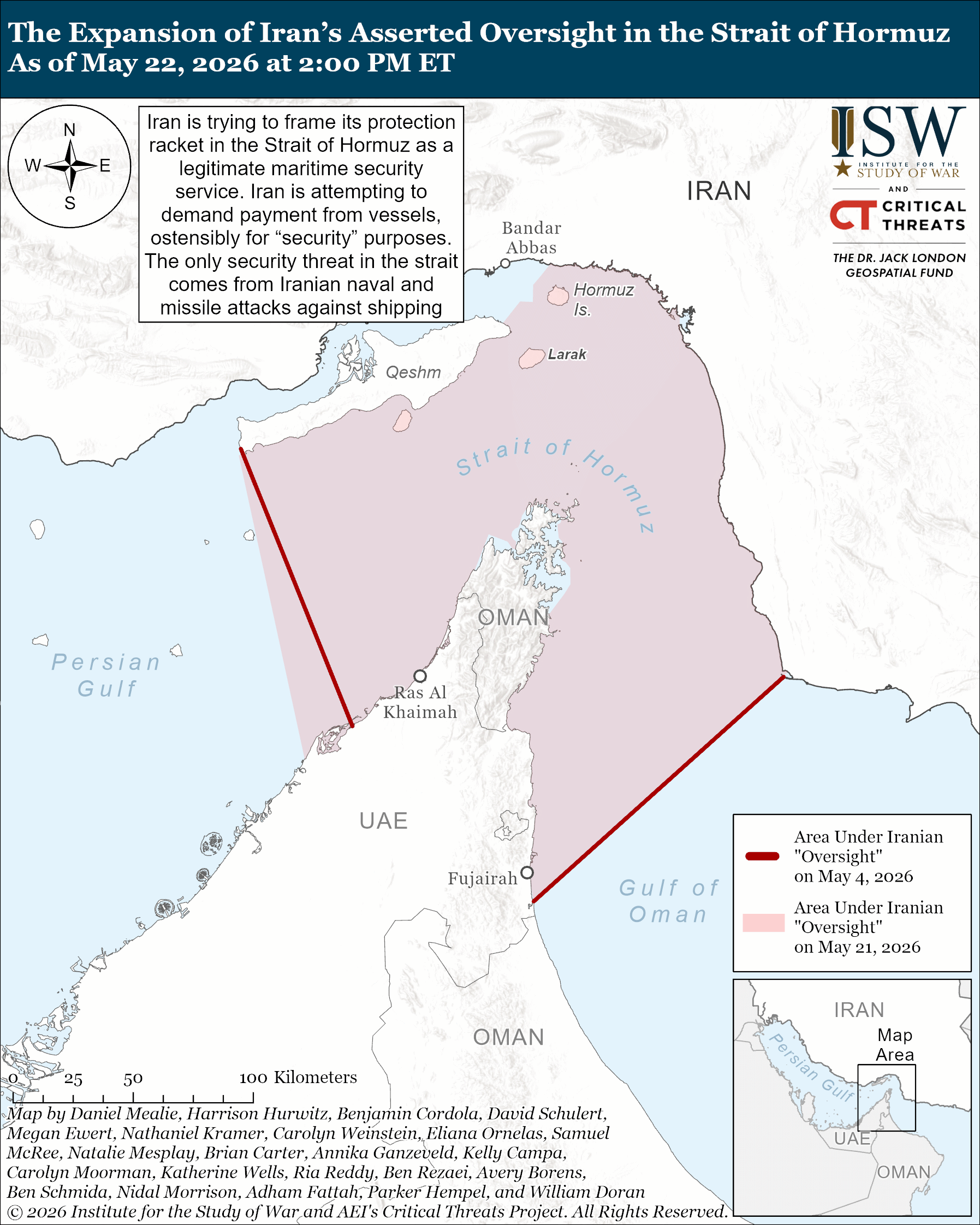
In the chart above, you will notice that Fujairah is in the red lines within its control. What’s incredibly interesting is that if you study a maritime chokepoint in Iran’s “axis of resistance” on the Middle East map, they have designed their grand strategy around targeting all the chokepoints.
Bab al-Mandeb: Houthis
Mediterranean: Hezbollah
Strait of Hormuz: IRGC
Thus, it should not be a surprise that Fujairah is within the Iranians’ control threshold. So it stands to reason that Fujairah, the hub accounting for ~6 million b/d of crude flow, will be the next major point of contention.
Why now?
The Iranians so far in this conflict have refrained from targeting tankers anchored at Fujairah or directly attacking the port. Despite that it’s common knowledge now that the S2S through the Oman lane is accounting for 1/3 of the crude flow pre-conflict through the Strait of Hormuz, we have seen restraint from the Iranians.
But that restraint will likely come to an end if the US does not capitulate and cede control to the Iranians.
The reason is quite simple. The timing coincides with both the midterm election and global SPR release.
First, the US midterm election is in November, but political campaigns are most active in August and September. It is the last push by politicians, so any last-ditch efforts will resonate with voters. With the Iran war already deeply unpopular with the majority of the US, any escalation would reduce the odds Republicans keep the Senate.
From a probability standpoint, the Democrats are already projected to win the House, but the Senate is still a toss-up.
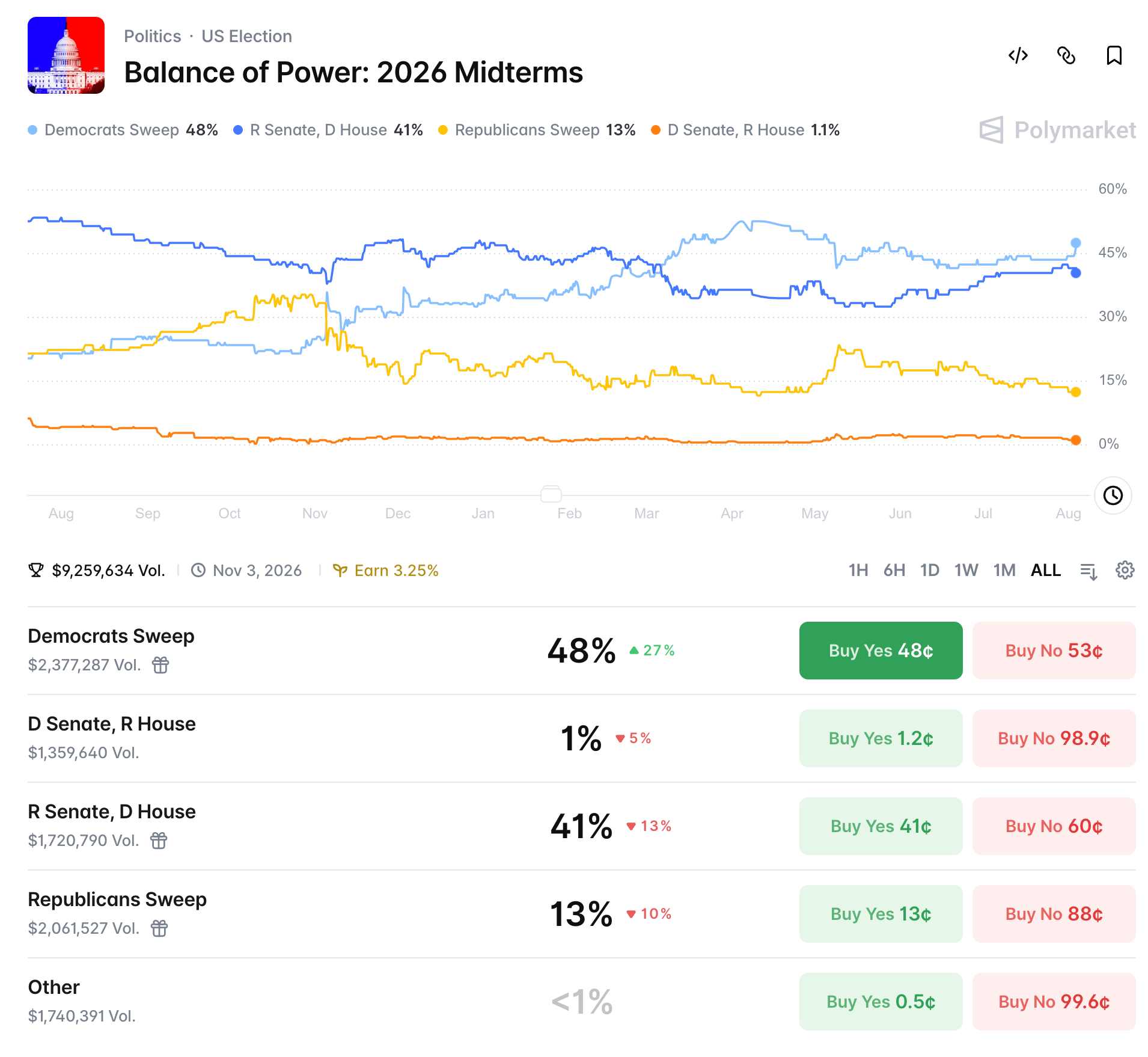
Source: Polymarket
Polymarket currently has a 48% chance of a Democrat sweep. President Trump understands that if both the Senate and House fall to the Democrats, the next 2 years will be spent battling an uphill battle. There’s even the possibility of being impeached, and the Iranians are gunning for “regime change” in the US.
To get the maximum benefit from an oil spike, the escalation table should align with the oil inventory math. Previously, we had expected US commercial crude inventories to reach operational minimums at the end of July, but ~150 million bbls of floating storage resulted in some cancellations in US crude exports. However, the recent tightening in the physical market is back thanks to renewed conflict, and the oil math drawdown resumes.
Now let’s assume that Iran knows that and the US SPR release disappears by the end of August; an escalation on Fujairah now would result in the global oil market losing an additional ~6 million b/d.
This would force the US to either escalate or fold to Iran’s demands. Currently, Energy Aspects saw global crude balance at a deficit of ~2 million b/d in July even with the shadow transits. If Fujairah is closed off, the deficit would jump to ~8 million b/d, sending crude prices spiraling higher.
By this point, even if China doesn’t buy crude, it wouldn’t matter.
All Roads Lead To The Same Outcome
Let’s use scenario analysis to explore possible outcomes. But what you will notice is that all roads lead to the same outcome.
Scenario 1: the US leaves the region and Iran is in control
Let’s assume that Trump decides that this war is too much, and he wants to leave the region. He folds completely, agrees to withdraw all of the troops, and hands Iran control of the Strait of Hormuz.
Iran will immediately turn around, continue to use the Strait of Hormuz as leverage, and demand concessions from Israel. You see, to become a regional hegemon means that you need to eliminate all threats.
Israel, which sees the conflict with Iran as all-or-nothing (similar to how Iran sees the conflict with the US), will just escalate, which will force the US back into the fold. Israel could threaten to bomb Iran’s energy infrastructure, which would force Iran to retaliate against GCC energy infrastructure creating a permanently higher plateau for oil prices because of structural losses in production capacity.
This means that scenario 1 is not even a plausible path to pursue. Iran will escalate even if the US capitulates, and Israel will force the US to re-enter down the road.
Lose-lose.
Scenario 2: US bombs Iran’s energy infrastructure, and Iran retaliates
Using the opposite of scenario 1, the US escalates by bombing Iran’s energy infrastructure, and Iran retaliates. Now the oil market no longer looks at whether or not the Strait of Hormuz opens by X date; it is wondering how much oil production infrastructure has been taken offline and how long it will take to repair.
The market, which previously expected 2027 balances to be in surplus, will have to push prices higher down the curve to reflect this structural supply loss.
This means that in the short-term, the only way to balance the global oil market is through demand destruction.
Now the caveat of scenario 2 is that if the Trump administration was willing to swallow this bitter pill for the sake of winning, then higher oil price and a global depression are the sacrifices they need to make. In such a scenario, there’s no certainty of winning, so we will eat the economic hardship for a “maybe,” which is not exactly an attractive risk/reward.
Scenario 3: Talks are ongoing, small strikes back and forth, and Trump is just trying to survive the midterms
This scenario is what’s currently unfolding. The US is using these 1 to 2 week strikes to temporarily knock out Iranian capabilities so it can conduct S2S to help buffer the global oil math. In the meantime, Trump is using his market moving powers to flush oil prices down using the same strategy of war on, war off, peace on, peace off.
So far, this strategy is working and it’s possible they can keep doing this dance until the midterms.
But for the Iranians, they also know that this is the playbook, which brings in the Fujairah card as an inevitability. If Iran does not play the Fujairah card during this window (August), then it will have lost leverage on the midterms and the oil math. Every day that goes by without enforcement in the Oman lane implies that Iran is losing leverage.
Logically, this means that Fujairah is next, which would pressure the global oil market like we’ve never seen before.
Scenario 4: Fujairah escalation. Trump threatens to strike; Iran threatens to strike back. What’s next?
Let’s say that scenario 3 unfolds. Iran hits Fujairah, demands compliance from tankers to get permits with Iran. The US immediately retaliates, but “peace talks” continue. By this point, the US will have two choices: fold or escalate.
If the US folds, we are back to scenario 1.
If the US escalates, we are back to scenario 2.
One Path
Now you can slice and dice the 4 scenarios above however you like, but there’s one inevitable path you land on: oil infrastructure being targeted.
You can have total capitulation from the US and end up with Israel targeting energy infrastructure. You can have escalation, which eventually ends up resulting in energy infrastructure being targeted.
No matter how you game this out, the inevitable is that some production capacity will be taken out, which will reset how everyone looks at this conflict. Instead of it being transitory, people will look at it as structural, which will completely alter how people trade crude and energy stocks.
Conclusion
If my logic is correct, the Fujairah escalation is the next major event for the global oil market. Because the Strait of Hormuz is an all-or-nothing conflict, diplomatic resolutions are only temporary half-measures that don’t solve the core problem. Either Iran controls the Strait of Hormuz and becomes the world’s most powerful oil producer, or the regime is toppled and everything goes back to normal.
So if you game this out, list all the possible scenarios, slice and dice each one, you ultimately come to the same conclusion: escalation.
I think that’s where we are headed and both the US and Iran understand how important Fujairah is at this point. Let’s see how this all unfolds.
Analyst’s Disclosure: I/we have a beneficial long position in the shares of USO, UCO, BNO either through stock ownership, options, or other derivatives.