

Editor’s Note: This article was first published to paid subscribers on June 23. The original article is made public below.
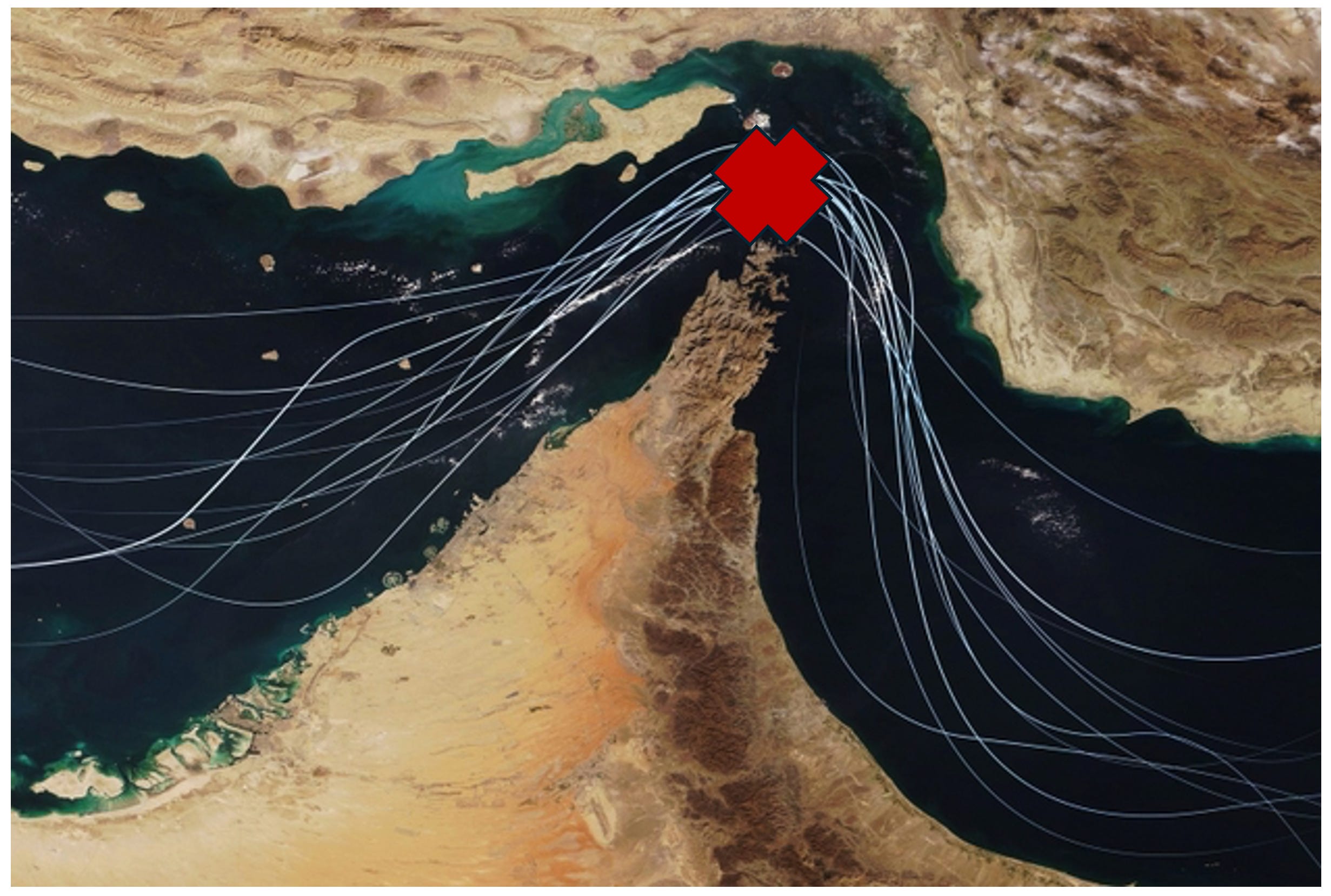
The market is incorrectly assuming that the Strait of Hormuz will return to normal. Since the beginning of the Iran conflict, I saw this geopolitical event as all or nothing. Either Iran comes out victorious and controls the Strait of Hormuz or the US succeeds in toppling the regime and restores the Strait of Hormuz back to normal.
There was no in-between.
Now that the MOU is signed, effectively giving Iran control of the Strait of Hormuz, we are never going back to the way it was. Unless, of course, the US tries to restart the conflict and comes out victorious, but outside of this scenario, Iran is now the most powerful oil producer in the world.
It has been a week since the MOU was signed and the latest tanker traffic data is becoming obvious. Following the conflict in Lebanon over the weekend, IRGC announced that it stopped issuing permits and the current tanker activity exiting the Strait of Hormuz is related to existing permit holders.
Over the coming days, this will become obvious. But what should be even more glaringly obvious right now is the tankers coming into the Strait of Hormuz.
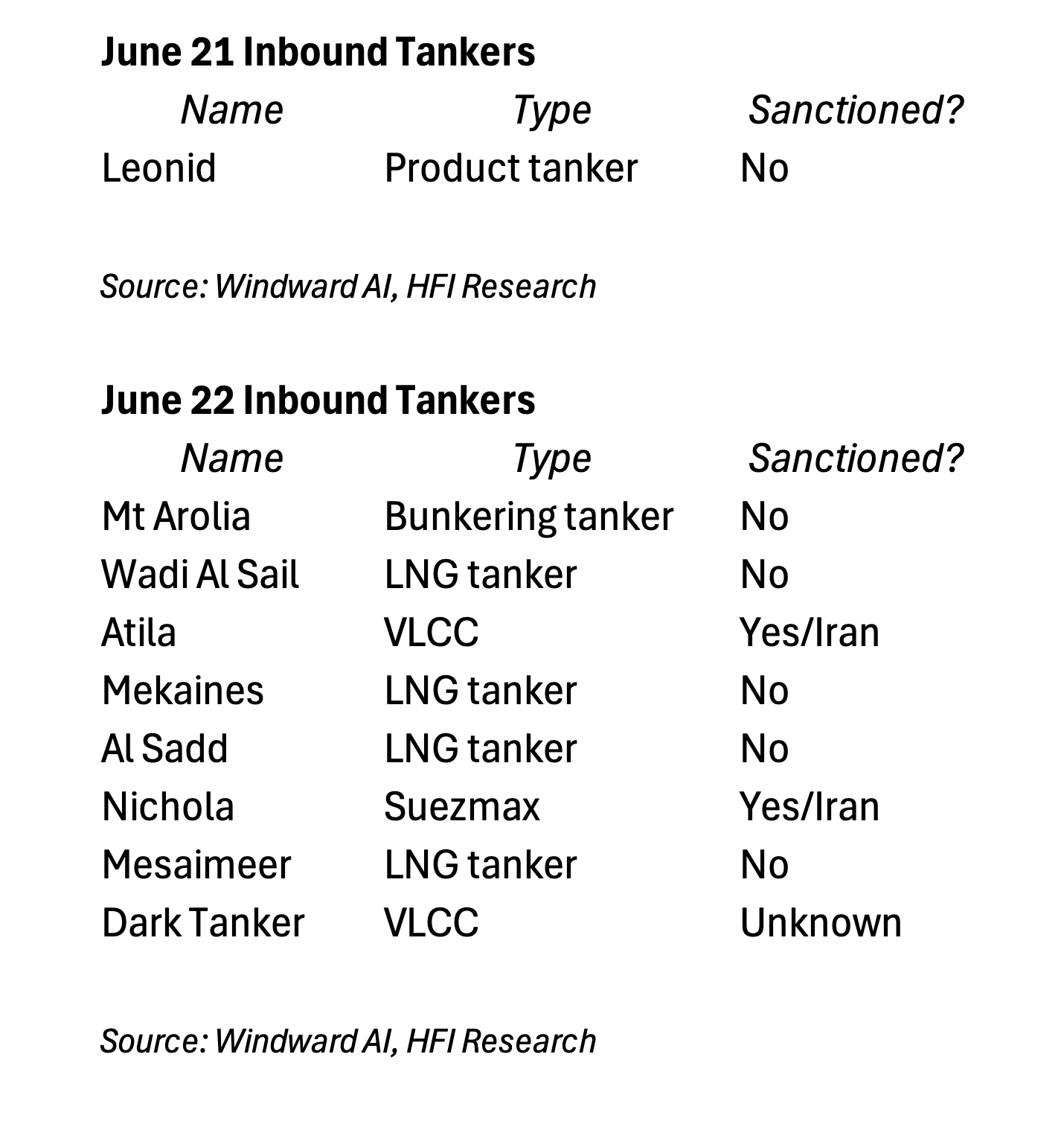
Since the announcement of the closure over the weekend, these are the tanker inflows for the last two days:
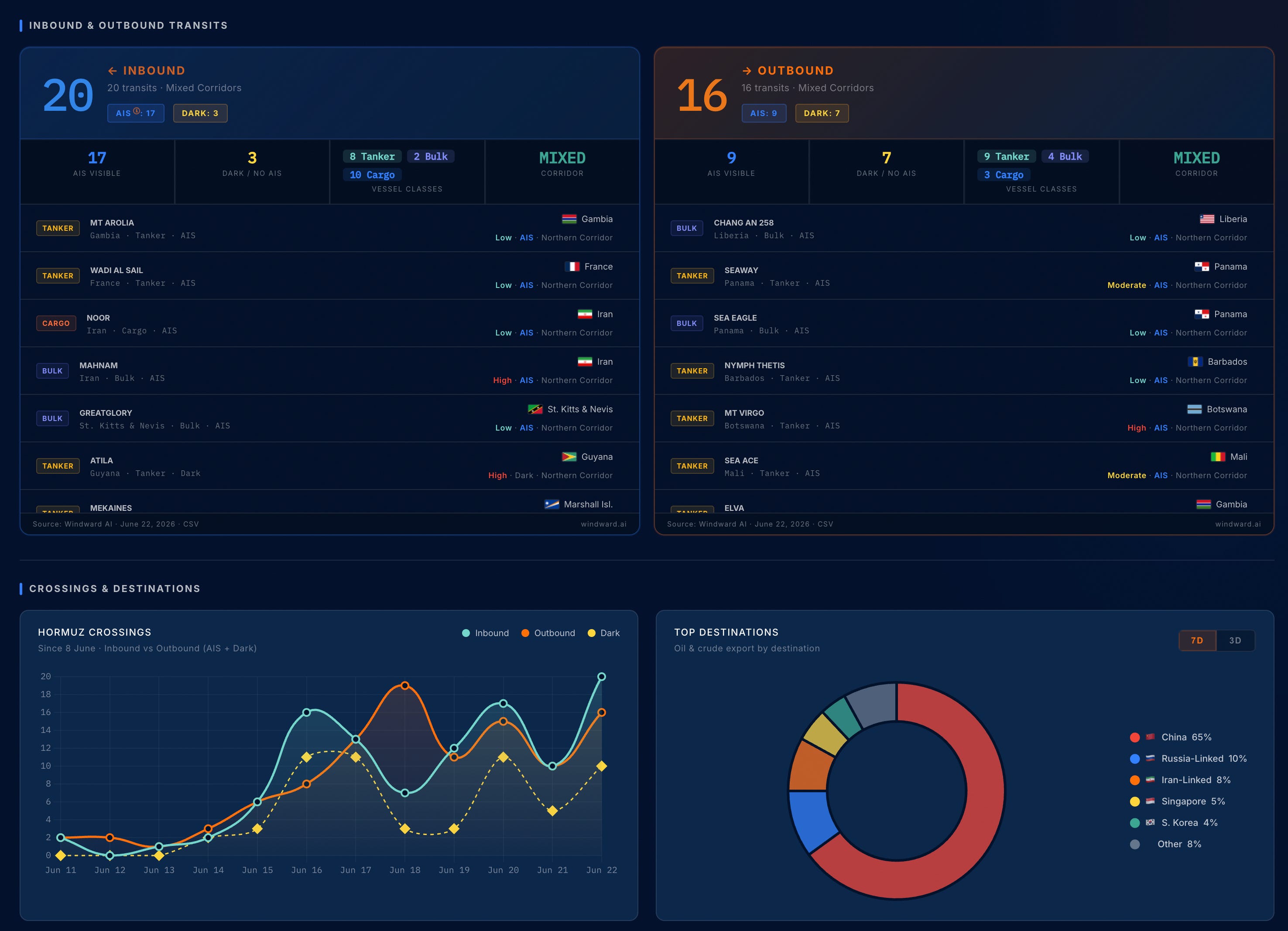
From a total vessel count, most analysts are looking at the bigger headline figures:
Source: Windward AI
But for the relevance of the oil market, production shut-in, we need to see sizable volumes of VLCCs going back into the Strait of Hormuz to change the math. At this moment, that is not happening.
Going forward, I will be publishing daily tanker counts, just like the table above, distinguishing between sanctioned and unsanctioned tankers and their types. That way, readers can see the emerging pattern, which is becoming obvious to me.
IRGC controls the Strait of Hormuz, and the inflow of crude-related tankers right now is dominantly going to Iran, with some leakage here and there for the others.
In my view, anyone assuming the Strait of Hormuz will return to normal is making a serious analytical mistake. This is especially true given the data that’s surfacing right now.
Variant Perception
It’s hard to believe that Brent is trading at $77/bbl, IRGC controls the Strait of Hormuz, 7 to 8 million b/d of crude oil production remains shut-in, and the market is max short Brent.
And the guy who’s long oil (me) is making a contrarian bet.
Unprecedented.
I don’t know whether I am currently stuck in the Matrix and the system is just messing with me, but this is the most surreal moment of my life so far. Either I am the stupidest person on the planet, or everyone has lost their mind. I think my view on the market is also about as binary as the setup I am seeing.
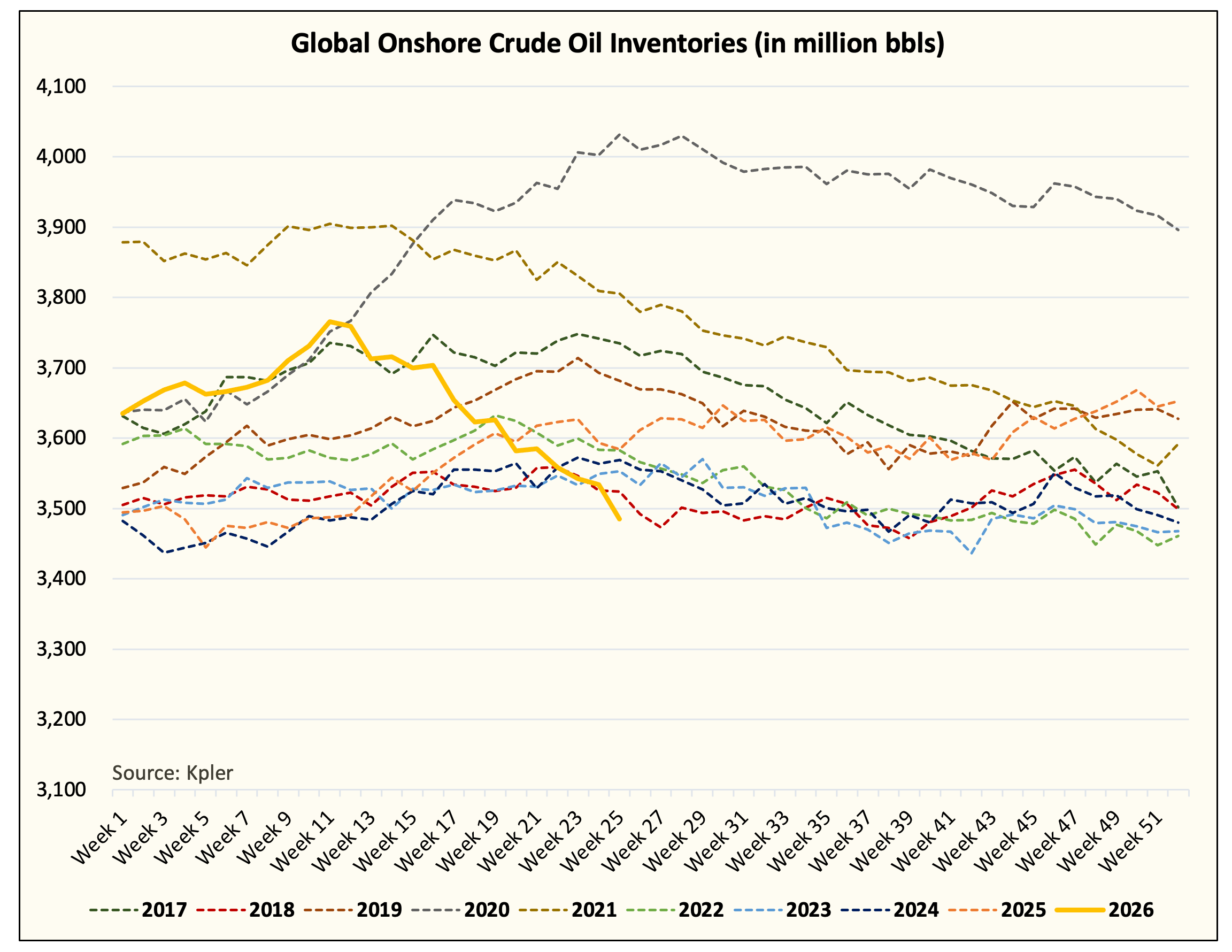
My variant perception of the oil market is simple. Everyone is in agreement on the onshore oil inventory draws.
Ex-China
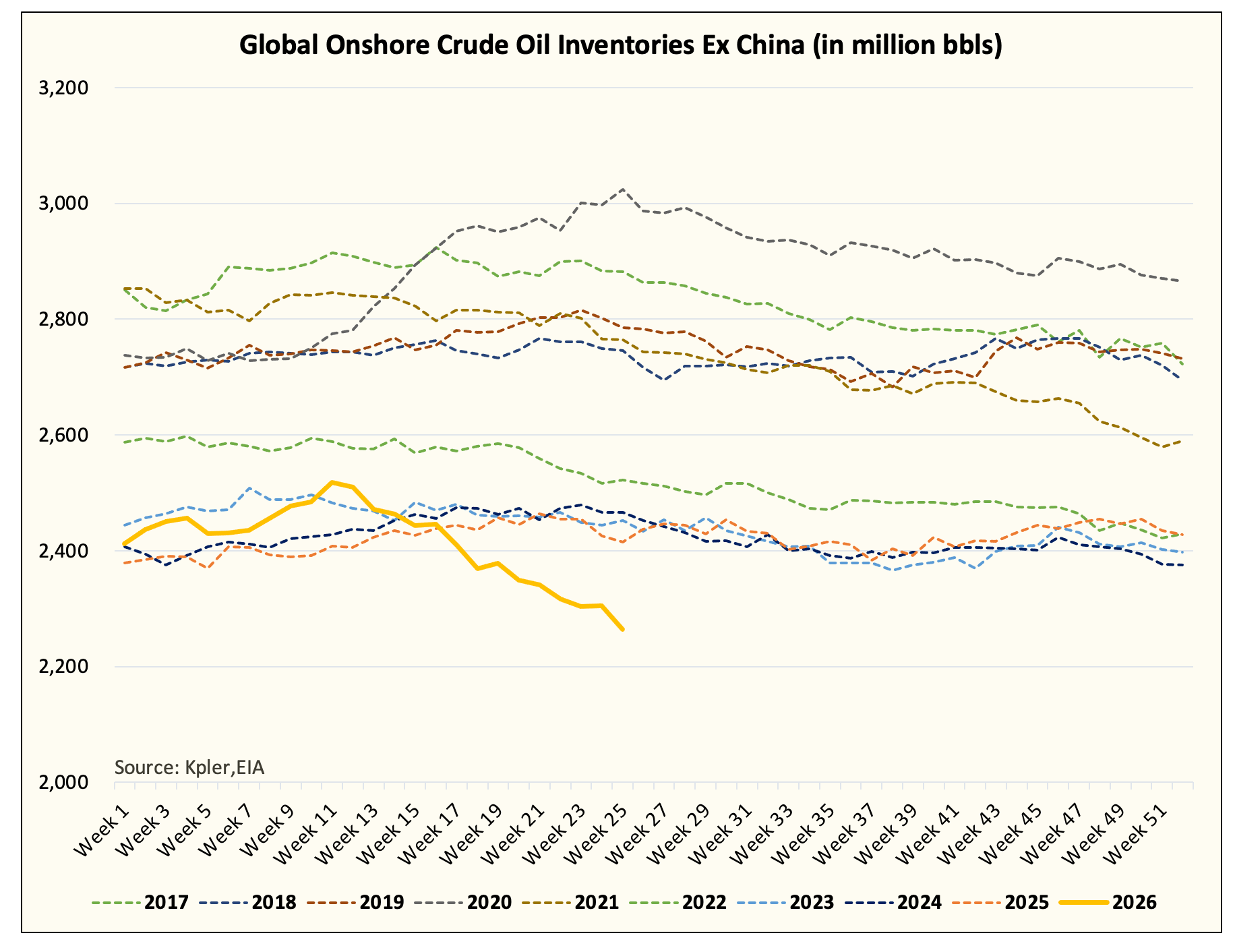
Operational minimums are coming, but most people, probably because of the price, have seemingly overlooked this scenario because they are assuming the Strait of Hormuz will return to normal. And as a result, the oil market will be flooded as production surges back.
Yes, perhaps they are right, but I can tell you right now, based on the tanker inflows, this couldn’t be further from the truth.
In the last 6 days, Kpler estimates that 64.492 million bbls have exited the Strait of Hormuz. On an implied flow basis, this is 10.75 million b/d.
From the market’s perspective, this looks like the crisis is almost over, but again, it’s more nuanced than that. First, most of the exit volumes are tied to Iran. More than 35 million bbls of Iranian crude have exited the Strait.
Iran has let stranded tankers out. This is not a surprise, given that many of them have been stuck inside for over 3 months.
But the oil math was always about inbound tankers more than outbound tankers. Without a steady stream of inbound VLCCs, oil production shut-in continues, eating away at the inherent deficit in the global oil balance. It doesn’t matter whether China is reducing imports or refinery runs; the molecule isn’t replaced.
And so far, the inflow is a trickle. No surprise, because the IRGC is firmly aware of the math. During the 60-day negotiation period, they will max out this leverage and throttle the flow under the disguise of granting permits. By throttling permits, they can effectively control who comes in and who goes out. So you would be a fool if you think they don’t know that controlling the inflow of tankers will ultimately decide how much production shut-in returns.
In addition to the logic I explained above, it is now evident, based on discussions with tanker owners, that the tanker rates offered for ships transiting the Strait of Hormuz are astronomical compared with other regions. Not only is the price insanely high, but operators are having trouble assembling crews willing to take the risk of going in.
So no, the issue is far from resolved, yet everyone still thinks it will somehow be resolved because both sides signed an MOU. Just wait until Trump finds out that IRGC is throttling flows and not actually de-mining the Strait of Hormuz. Will he just ignore this reality and play along or will he have to face the inevitable choice of escalation?
I don’t know, and I don’t really care. What I do care is the number of tankers going in, and right now, the market is going to be very wrong about this because the IRGC is going to throttle flows.
This situation is worsening. The market has priced it as if it is resolved. This disconnect is why I am still bullish oil. Nothing more, nothing less.
Catalysts
In a normal oil market, every day that goes by, losing 7 to 8 million b/d should be a catalyst in itself. But clearly, we are not in a normal oil market because we have max Brent short positioning at a time when the conflict is far from resolved.
So let me go back to the first principle. What were the signals at the beginning?
Crude timespreads
Crack spreads
Onshore inventory draws
We are 2 for 3. Crack spreads remain elevated. Onshore oil inventories continue to decline. But crude timespreads are weak.
Why are crude timespreads weak?
Simple.
Brazil, Russia, Venezuela, and US crude exports are up 2.2 million b/d y-o-y.
China crude imports are down 4.7 million b/d y-o-y.
Net: 6.9 million b/d delta.
OPEC crude exports are down 7.162 million b/d y-o-y.
Middle East crude exports are down 0.151 million b/d y-o-y.
Total: 7.313 million b/d.
The 6.9 million b/d delta swing, vs. the 7.313 million b/d decrease in crude exports, explains why we are not seeing panic in the oil market.
Over 68% of the delta belongs to China, so the question is simply: when will China buy crude again?
With sanctions on Iranian petroleum exports lifted, China will come in and buy all the barrels. At the start of the conflict, China banned product exports due to national security concerns. If the US comes out victorious and controls the Strait of Hormuz, it poses an existential risk to China; if Iran controls it, China gains major leverage.
Now that Iran controls the Strait, China will likely lift the product export ban and return the discrepancy between elevated crack spreads and depressed crude timespreads.
This is why it’s important, but first, let me explain what happens in a normal oil market:
Refining margins are a function of end-user demand, refinery throughput, and storage.
If refinery throughput is maxed out, and storage is low, and margins are up, that means demand is good.
In a normal market, crude timespreads go up because refineries that can increase would buy the crude and increase.
Since teapot refineries are currently operating at 50% (historically at 65%), they have significant spare refining capacity. By banning exports, you suck the marginal buyer of crude out of the market. These guys will buy crude if it means they can make $0.50 per barrel. That’s why Asian refining margins are usually depressed.
Once the product export ban is lifted, teapot refineries will pick up spot cargoes and lock in margins. This would, in theory, compress refining margins and lift crude timespreads higher. And since we have max short positioning in Brent, any reversal in timespreads will signal to CTAs to exit the market, creating a stampede.
And here is the caveat. Since refining margins continue to inch higher despite maxed-out throughput, and product storage is very low, even if Chinese teapot refineries start exporting products, crack spreads won’t necessarily crash. And like I said earlier, as long as these guys make money, they will buy the crude. So we could have a scenario where crude squeezes back up and refining margins keep pacing, creating a vicious cycle.
Now, could this happen soon?
Possibly. The market rumor is that Chinese refineries are increasing throughput in July. Now, if there were no product export ban lift coming, why would they keep producing at compressed domestic pricing margins?
I guess you can never know, but this is one of the first positive signals I’ve seen on the China front.
Outside of the China variable, the fact that inflow tankers will continue to illustrate the phenomenon I’m seeing, which is that the IRGC is firmly in control, should, in theory, be a catalyst in itself.
But again, you just never know with this market. Anything is possible and anything can happen.
Conclusion
The Strait of Hormuz is not going back to normal. All the sell-side analysts and others who are estimating normalized flow are making a big mistake. With the IRGC in control, Iran is now the most powerful oil producer in the world. They can throttle flows through the permit mechanism and you can bet money that these guys are tracking just how much implied oil flow is going through the Strait of Hormuz.
And to help clarify the math, it is very simple.
Pre-conflict flow: ~20 million b/d.
By-passes: 6.5 million b/d (conservative).
Net: 13.5 million b/d.
To achieve the desired deficit, throttle flows below ~13.5 million b/d. If the oil market is projected to be in a ~3 million b/d surplus, throttle flows to 9 million b/d, and you have a 1.5 million b/d deficit.
And if you want prices to go higher, throttle flows below ~9 million b/d.
Only time will tell who is right, but my job will be to track the daily tanker flows and report back. I will stay focused on what’s important and what’s important is the tankers going in, not the tankers going out.
Analyst’s Disclosure: I/we have a beneficial long position in the shares of USO, UCO, BNO either through stock ownership, options, or other derivatives.