

Gaslighting
Psychological manipulation of a person usually over an extended period of time that causes the victim to question the validity of their own thoughts, perception of reality, or memories and typically leads to confusion, loss of confidence and self-esteem, uncertainty of one’s emotional or mental stability, and a dependency on the perpetrator.
The act or practice of grossly misleading someone especially for one’s own advantage.
- Merriam Webster Dictionary
I did not come up with this article title. It was inspired by Nelson Wu of Open Square Capital, whom I highly recommend. He recently published a piece titled “A Glut of Supply: Gaslighting the Market.”
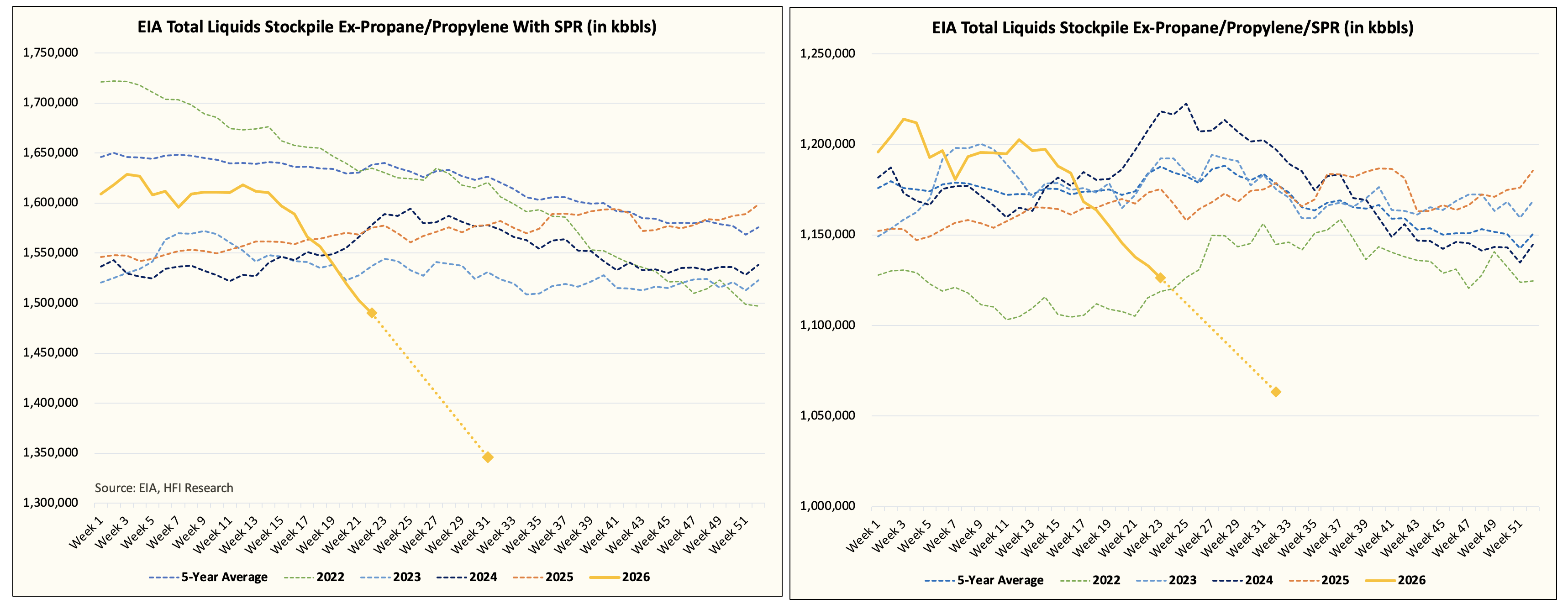
It is amazing to sit here today, admiring the fastest onshore oil inventory draws in history, and watch market participants convince themselves that because WTI is trading around $92/bbl, there’s no supply issue.
Some have even taken the more adventurous route of saying that the y-axis needs to be changed to zero to avoid exaggerating the level of inventory draws we are seeing today.
What an amazing time to be alive.
Despite living through COVID, which I thought was a once-in-a-lifetime event, I can say with a high degree of confidence that there’s nothing like what we are seeing today, not even COVID.
As with anything in markets, there are people with lucid thoughts, and there are people who get bogged down by irrelevant facts, like how the y-axis needs to be fixed at zero, and never mind the fact that oil inventories can’t physically go to zero (tank bottom, linefill, etc).
But we live in a perilous time where facts are becoming irrelevant because narratives and vibes are the only things that matter.
It is what it is.
Gaslighting the Market
The global oil market has somehow convinced everyone that we do not have a crude shortage today, but instead, a product shortage.
That’s funny.
Refineries, as of this writing, continue to benefit disproportionately because of a combination of factors:
China banned petroleum product exports. Teapot refineries used to flood Asian markets with cheap petroleum products. But thanks to the price cap, mandatory refinery utilization floor, and export ban, teapot refineries have, in essence, subsidized the Asian economies.
Refineries without access to crude have reduced throughput to manage the crude storage available to them, further tightening product supplies.
Governments are releasing crude from strategic petroleum reserves (SPR).
So what was once a crude supply shortage has instead reversed itself into a product shortage:
-11 million b/d of crude oil production shut-in
+5 million b/d of refinery throughput (-3 million b/d in China, -2 million b/d elsewhere)
+2.5 million b/d of SPR release
+3.5 million b/d of crude oil storage drawdown
And while I think this is arguably one of the funniest things I’ve ever seen, people have seemingly forgotten that a reduction in refinery throughput does not equate to demand destruction. Product inventories are still drawing down around the globe, so unless you had COVID-like demand destruction, the barrels are still lost; whether that’s in crude or product storage is not relevant.
But the market has successfully gaslit even the oil traders themselves into believing that crude is not in short supply. Never mind the fact that the most visible oil inventory in the world, the US, is showing the largest and fastest crude inventory draws in history; everything will be fine.
I mean, we are going to get an MOU signed tomorrow, and the Strait of Hormuz will open, right?
But I think the most amusing thing I’ve read of them all is this idea that dark fleet transits are happening under our noses and that the Strait of Hormuz is actually open to the global oil market, it’s just not being tracked.
I’m sure you’ve seen commentary from a very infamous journalist in the energy community talking about how the UAE tendered 14 million bbls without mentioning that the barrels are offered at Fujairah, the very bypass the UAE created to circumvent the Strait of Hormuz.
Or how about this one, another favorite of mine:
There are secret ship-to-ship transfers that are allowing some countries, such as Saudi Arabia, the UAE, Kuwait, and Iraq, to reduce domestic onshore crude oil inventories. I mean, the Strait of Hormuz must be open, right?
Again, facts seem irrelevant these days because people prefer to peddle narratives over reality.
So here’s a dose of reality check: we are approaching the summer months, and power burn demand in the Middle East requires these countries to burn crude oil. To satisfy domestic demand consumption, they need to increase production, which means they need to drain onshore crude inventories.
First, they need to offload some crude inventories to empty VLCCs, then they need to restart just enough production to meet the higher domestic power burn demand needs over the summer.
During peak summer burn demand months, crude volumes could go as high as 1.5 million b/d.
But the increase in production here is not relevant to the global oil market picture. These countries would never import crude, so an increase in domestic consumption through higher production has no bearing on the rest of the oil market.
So as I’m sitting here and reading these narrative pushers one-upping one another for the sake of publicity, I just laugh. I think it’s amusing.
And last but not least, we have also convinced ourselves that inventories are irrelevant.
“Why do inventories matter if Trump will just get a deal in the next few weeks?”
Yes, oil inventories are irrelevant. The market, which has “balanced” itself by drawing down oil inventories excluding China at 5.5 million b/d, does not care about inventories because inventories are the only thing preventing us from an outright shortage today.
Well, I hate to break it to you, but we are 6 weeks away from global onshore crude inventories including SPR reaching operational minimums.