Let’s say that the Democrats take both the House and the Senate; what can Trump do?
Choice A: Bomb Iran because he’s mad; now everyone can pin higher oil prices on him. And it won’t really change anything on the ground.
Or...
Choice B: Do nothing, keep the status quo, and blame the Democrats for higher oil prices (to come) after the Midterms.
If this administration has done “literally” everything possible to suppress oil prices up to this point, then a rise from $100 to $150 would be far worse than a rise from $70 to $100.
You see, people have short-term memories. Right now, people associate higher oil prices with the Iran war. If Trump bombs Iran after the Midterms, it would give people a reason to keep associating him with higher oil prices. He doesn’t want that.
Inversely, if he doesn’t bomb Iran after the midterms, but suddenly, if oil fundamentals show up in higher prices, he can blame the Democrats.
You can already imagine him going on TV uttering something along the lines of, “Democrats won, so now oil prices are surging. I already won in Iran. They have been defeated.”
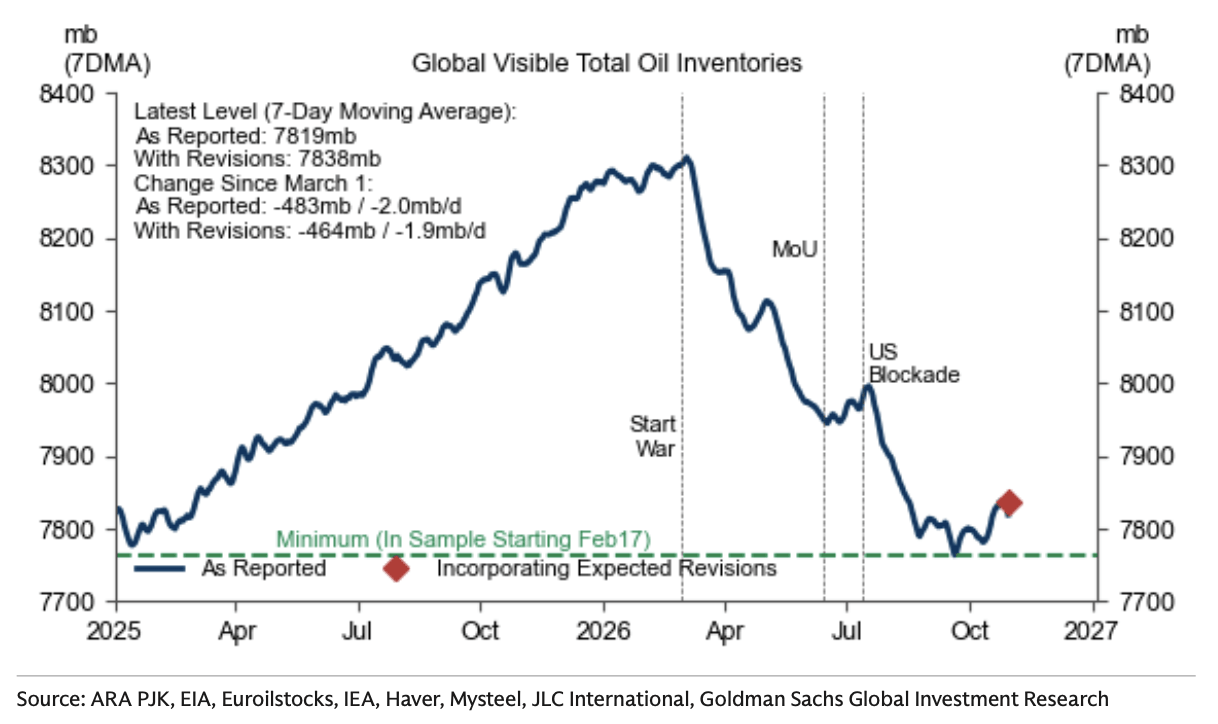
And yes, crude oil isn’t being properly valued today because this conflict will last much longer than you think. The Strait of Hormuz issue remains an all-or-nothing conflict, and the longer it drags on, the lower oil inventory buffers will get.
But what does Trump gain from blaming Democrats for higher fuel prices?
It’s a classic shift-the-blame tactic.
Now, if you reverse it and say the Democrats win, but oil prices fell, it would be seen as the Democrats pushing oil prices down. And in politics, it doesn’t matter what’s right or wrong; what matters is how people perceive it.
I concluded the scenario section with the following:
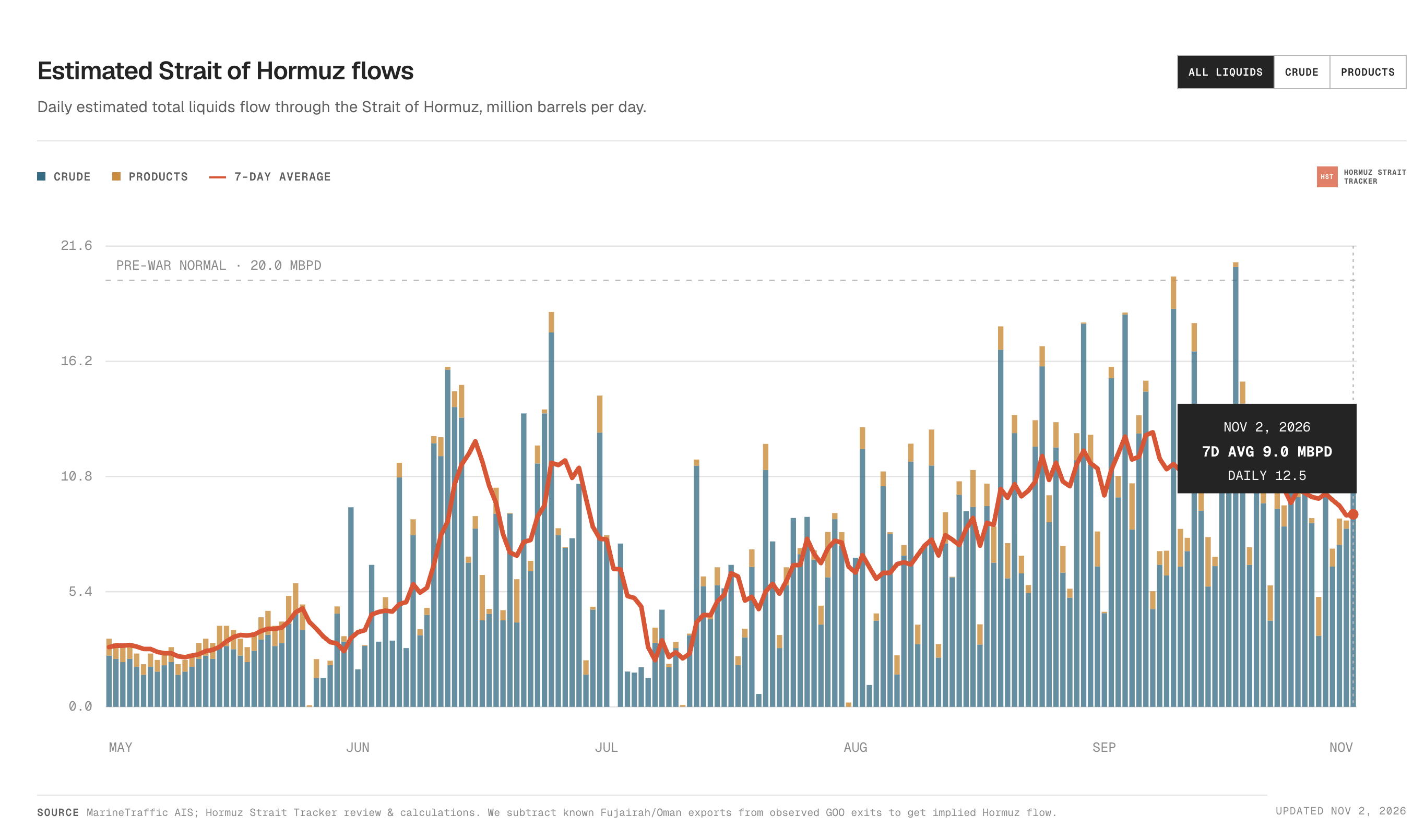
Now, if you mix and match the scenarios above, you can see how scenario 1 is the more enticing option. The current Strait of Hormuz escorts, despite the daily tanker attacks, are enough to prevent the world from running into imminent shortages before year-end (and before the Democrats take over). Implied flow today is around ~9 million b/d, above the 3-4 million b/d panic scenario I described last week.
As a result, from an incentive standpoint, it is in Trump’s interest to keep the status quo, but blame any increase in oil on the Democrats.
Put simply, whatever happens to oil AFTER the midterms will be seen as irrelevant to Trump. We know that’s not the reality, but I believe that will be the framing. This is one way he can try to get out of this situation reputationally without having to actually do anything militarily.
The oil market’s initial reaction following the blue tsunami was to assume that the war was over. Geopolitical risk premium evaporated, and peace deal headlines have everyone convinced that kinetic action is over.
My view on this is different than most people’s. When I look at this issue from an incentive standpoint, Trump fully understands and appreciates just how terrible this Iran War is for the American people. I believe they have done an amazing job in suppressing crude oil prices with the frequent fake headlines to the occasional VaR shocks that Brent is in the low $90s, barely $20+ from pre-war levels.
For now, most people are attributing $4 gasoline to the Iran War, but if the status quo continues and gasoline ultimately hits $6 per gallon, it wouldn’t be difficult to “shift the blame” to another source.
No matter how you look at it, Iran’s current 7-point is completely untenable. The US cannot leave the region; it cannot pay Iran war reparations, and it cannot release sanction funds. These are all irreversible acts. The US also lacks the political willpower or ability to force Israel out of Lebanon, which invalidates point 1 of the 7 points. The market is again incorrectly assuming some peace deal is coming, but I don’t think it’s wrong in assuming no strikes are coming.
But I’m here to tell you even the status quo is unsustainable.