


This week’s WCTW (what changed this week) is a bit different than usual. Normally, I focus WCTW topics on fundamental changes and how they affect energy investments, but this topic has been bothering me for quite some time.
I think the trigger was today’s Goldman report, which explained that despite ongoing conflicts in the Strait of Hormuz, it expects Gulf production to gradually recover.
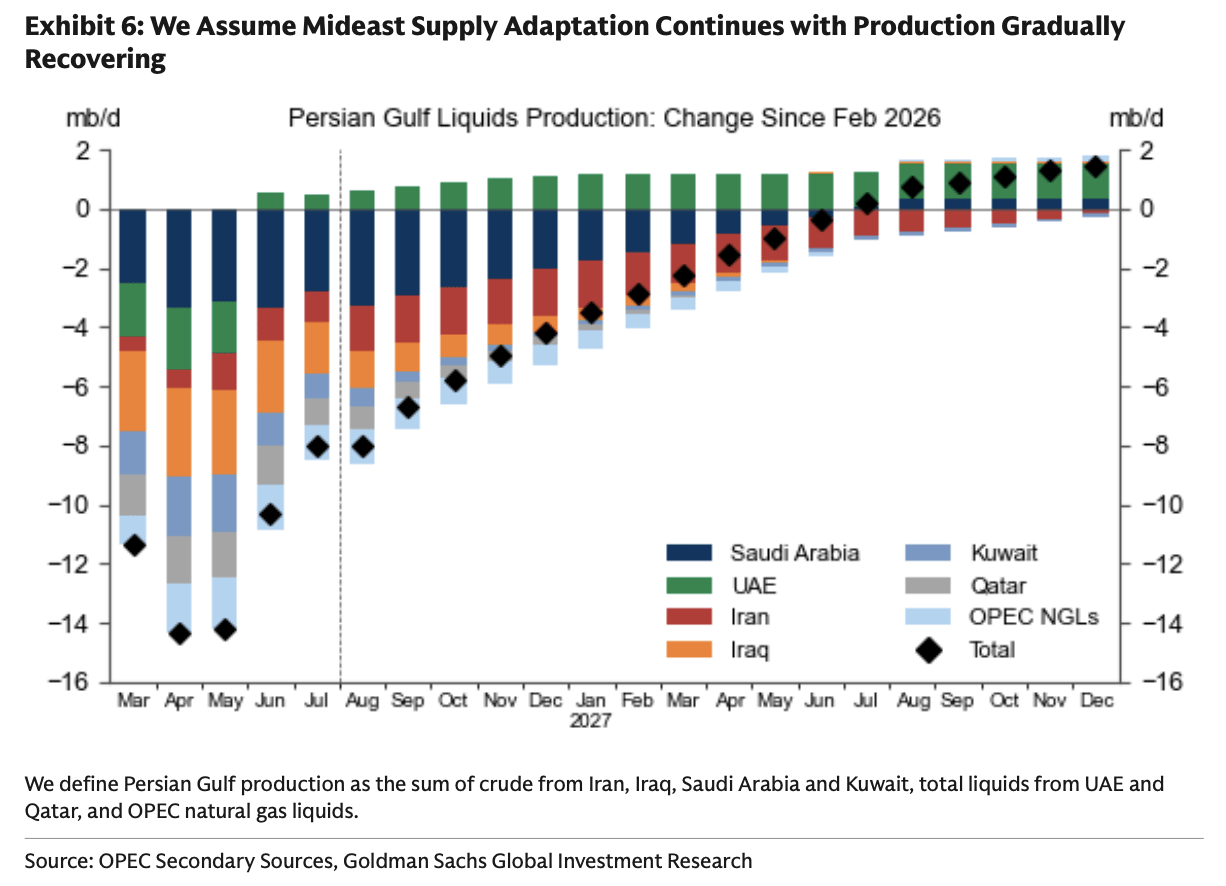
I will quote directly from the source:
We assume Mideast supply adaptation continues, with output recovering as dark flows rise, new pipeline capacity comes online in late 2027, and the UAE and Saudi Arabia eventually deploy some spare capacity.
Gulf liquids output has already improved from 14.3mb/d below Feb26 levels in April to 8.0mb/d below in July. We assume output gradually returns to pre-war levels by 2027H2, then overshoots as the UAE, now outside OPEC, and Saudi Arabia use some spare capacity to help rebuild inventories (Exhibit 6).
We view gradual further increases in Gulf Exports as a reasonable base case for two reasons.
First, exports have already trended higher, suggesting producers and specialized shippers are adapting to a risky shipping environment, including with rising dark flows (Exhibit 7), given strong economic and national incentives.
Second, additional resources—especially pipelines, tanker fleet expansion, and potentially additional ship protection—could support further export gains. We estimate 3.8mb/d of new effective pipeline capacity addition by end-2027, driven by the UAE’s West–East pipeline expansion (+1.8mb/d) and Saudi Arabia’s Yanbu port expansion (+2.0mb/d) (Exhibit 8).
To be clear, the intensity and geographical breadth of tanker attacks—a highly uncertain variable—will remain a key driver of whether Gulf oil exports recover and how quickly.
And of course, I highlighted the most pertinent part of that entire analysis at the end. It’s funny to read an analysis on Gulf production only to have the geopolitical aspect as an afterthought rather than the base case.
Um... shouldn’t you figure out whether the base case is continued disruption first, before figuring out whether production will recover, like someone clicked Excel drag on the spreadsheet?
Let’s be real here for a second; this cannot be that obvious.
But my favorite part of Goldman’s analysis is that despite the ongoing conflict in the Strait of Hormuz, it revised its Brent and WTI price targets higher for Dec 2026 by...

$5/bbl!
Yes, it now expects $85 Brent and $80 WTI.
Now now, let’s be nice. Never mind the fact that Brent February contracts are already trading at $89.49. I’m sure Goldman has its reasons for being so brave with such an amazing market call.
All kidding aside, sell-side firms in the US have all lost their minds since May. It’s as if they have all lost the ability to think. The only sensible oil market research I read nowadays comes from their European counterparts.
It’s crazy when you put it like that.