

By: Jon Costello
Editor’s Note: WOMM (What’s on My Mind) is a new weekly publication from Jon Costello. Please consider supporting Jon’s work by signing up for HFIR Ideas.
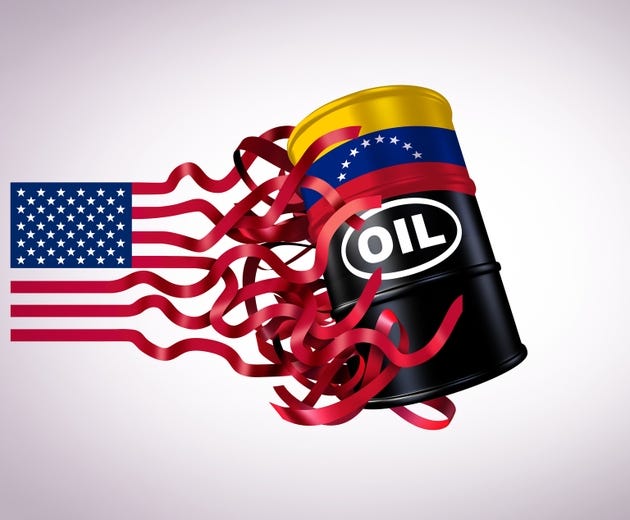
A land grab is underway in Venezuela’s oil industry.
After years of sanctions, political instability, deteriorating infrastructure, and a hostile investment environment kept most foreign capital away, companies are moving back in. Chevron (CVX) is planning billions of dollars of additional investment. Eni has committed to a new heavy-oil development. Other international operators are pursuing opportunities, and the United States has backed an effort to redevelop 17 Venezuelan oilfields containing enormous quantities of crude. Venezuela currently produces only around 1.2 million barrels per day, compared with more than 3 million barrels per day in the late 1990s, so the opportunity to restore lost production is substantial.
It merits a look.
But I want to be clear at the outset: I don’t particularly like investing in land grabs unless I’m properly equipped to evaluate the risks or can participate with very little capital at risk. Those risks are most acute in the earliest stages of a land grab, which is where Venezuela appears to be today.
When capital suddenly rushes into a market that was effectively closed only a short time earlier, investors are being asked to make long-term decisions before anyone really knows what normalized conditions will look like. Asset prices, contractual terms, competition, regulation, and political relationships are all being established at the same time.
That is not an environment in which I find it easy to commit capital.
Why I’m Wary
The opportunity in Venezuela is especially complicated because the risks have very little to do with whether the oil exists.
Venezuela possesses some of the largest petroleum resources in the world. The bigger questions concern everything surrounding those resources: who ultimately controls them, what fiscal and contractual terms operators will face, how much capital will be required to drill the oil, rebuild the supporting infrastructure, transport it, and get it to export markets, how durable those arrangements will prove, and what protections investors will actually possess if conditions change.
These aren’t theoretical concerns.
Reuters has reported that aspects of the rapidly emerging Venezuelan investment framework are already raising concerns among major international producers, particularly around contract stability, legal protections, transparency, and the structure of recently negotiated agreements. ExxonMobil (XOM) and ConocoPhillips (COP), whose Venezuelan assets were nationalized in 2007, are among the companies approaching the country’s reopening cautiously.
That history is difficult for me to ignore.
At HFI Research, we have considerable experience investing in Latin American oil and gas companies. For my part, I have been doing so as an outside passive equity investor since 2008. Since then, Latin American names have been among the largest holdings in the funds I manage.
That experience has taught me that the region can offer extraordinary resources and tremendous investment opportunities. It has also taught me how quickly circumstances outside management’s control can overwhelm what initially seemed like a sensible business plan.
Governments change. Fiscal regimes change. Regulations change. Contracts can change. And these changes are rarely telegraphed in advance. They can arrive suddenly and completely alter the investment’s economics.
I like investing in businesses where I can develop a reasonable idea of what management intends to accomplish and then watch that strategy unfold over several years. In parts of Latin America, the chessboard itself keeps moving. A rational strategy today can become considerably less attractive because of an election, a tax increase, a regulatory decision, or deteriorating relations with the government.
My time horizon makes those risks particularly important. When I make an investment, I generally look out at least five years, preferably longer. I am therefore less concerned with whether conditions are favorable today than with whether I can reasonably expect the conditions underpinning an investment to endure through my holding period. The longer the horizon, the more opportunities there are for governments, contracts, fiscal regimes, and political relationships to change.
Venezuela takes that problem to another level.