

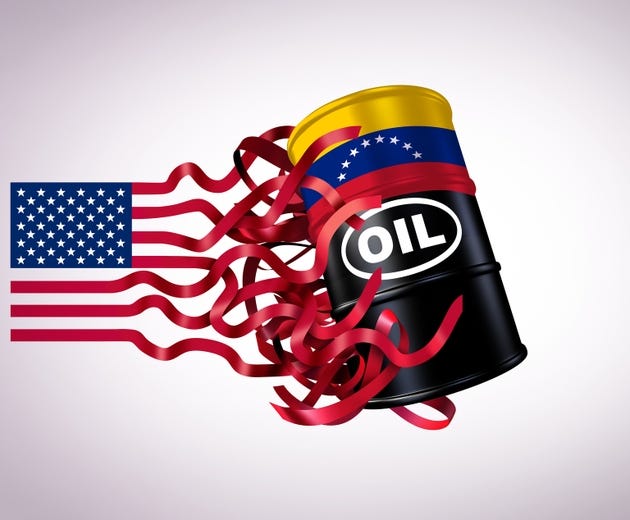
On Jan 3rd, the US successfully captured Venezuelan President Nicolás Maduro and took him into custody. At the time, we gave our general thoughts about the regime change and its impact on the oil market. But a lot has changed since then. Our initial belief that the procedural changes would take time has been proven inaccurate. Instead, what we are seeing is a rapid change from both the US and the Venezuelan side to expedite investment and the restart of the oil industry.
In this article, I will give you a breakdown of the following:
All the changes that have taken place.
The impact on the global oil market.
Potential investment opportunities.
What Changed?
The Trump administration has moved aggressively to reopen the Venezuelan petroleum sector to the US and allied commercial interests. Between the end of January to mid-February, the US Department of the Treasury’s Office of Foreign Assets Control (OFAC) issued a series of General Licenses that systematically unraveled the sectoral embargoes imposed under Executive Orders 13850 and 13884.
General License 46A: Authorizes established U.S. entities to engage in the lifting, exportation, sale, and transportation of Venezuelan-origin oil. Contracts must be governed by U.S. law. Reporting to the State Department is required every 90 days.
General License 47: Permits the export, supply, and delivery of U.S.-origin diluents to Venezuela, critical for blending extra-heavy crude. Prohibits transactions with persons in Russia, Iran, North Korea, Cuba, or the PRC.
General License 48: Authorizes the provision of goods, technology, and software for the exploration and production of oil and gas. Expressly prohibits the immediate formation of new joint ventures without separate licensing.
General License 49: Allows for the negotiation and entry into “contingent contracts” for new capital investments in the energy sector. Actual execution and performance of these contracts remain contingent upon future specific OFAC authorization.
General License 50A: Provides targeted authorizations for specific major U.S. and European energy companies to resume designated operations. Excludes the use of debt-for-oil swaps, gold payments, or Venezuelan digital currencies like the petro.
With these general licenses in place, US and foreign oil companies can now invest in Venezuela.
The other big change was to the payment mechanism. One of the main concerns for capital flows to Venezuela was the billions in international arbitration awards held by multinational companies. To prevent legacy creditors from immediately seizing new oil revenues through international courts, President Trump promulgated Executive Order 14373 on January 9.
Here’s how the new payment structure works:
Under the new General Licenses (GL 46A and GL 48) issued by OFAC, foreign oil companies are prohibited from paying the Venezuelan government or PDVSA, the state-owned oil company, directly.
Any royalties, federal taxes, or production levies owed to Venezuela must be deposited into US-controlled accounts known as “Foreign Government Deposit Funds.” This was established under Executive Order 14373.
Companies are only allowed to make direct payments to Venezuelan authorities for routine local taxes, permits, and fees. This avoids any potential mishandling of funds from the oil revenue.
To access the oil revenues held in the US accounts, the Venezuelan acting government must submit a “budget request” to Washington DC, which authorizes the release of funds for approved purposes, such as importing medicines and medical equipment. This mechanism effectively chokes off any potential disruptions to the oil industry and gives the US effective control of all of Venezuela’s finances.
Note: It is incredible to think just how powerful the US is when you read the specific mechanisms.
The payment arrangement also explicitly prohibits the following (General License 50A):
Debt-for-oil swaps, this effectively nullify all of the Chinese deals made in the past.
Payments using gold.
Venezuelan state-issued digital currencies.
Not only are drastic changes happening on the US side, but there were profound changes made on the Venezuelan side.
On January 29, the Venezuelan National Assembly enacted sweeping amendments to the Organic Hydrocarbons Law. Without these changes, the US General Licenses would not have been enough, and here’s why:
Direct Private Participation and Contractual Freedom: The reform explicitly repeals the 2006 law that reserved upstream activities to the state. It also repeals the 2009 law reserving hydrocarbon-related assets and services to the state. Private companies in Venezuela can now hold direct upstream contracts for exploration, extraction, collection, transportation, and storage without the historically mandatory requirement of majority state ownership (this is a big deal, more on this later). In addition, these upstream contracts are exempt from traditional Venezuela public procurement laws, which dramatically streamlines their negotiation and execution.
Minority Shareholder Empowerment: In existing “Mixed Companies” (join ventures with PDVSA), minority foreign partners are now legally permitted to exercise direct technical and operational management (another big deal, more on this later). This bypasses PDVSA’s notorious bureaucratic inefficiencies and technical deficiencies. Furthermore, minority partners can now directly market their share of the production and independently open and manage bank accounts in any currency and jurisdiction offshore, thus drastically mitigating local currency devaluation risks and capital repatriation risks.
Arbitration and Dispute Resolution (arguably, the most important change implemented by Venezuela): A major impediment in the past on energy investment has been Venezuela’s insistence on local judicial jurisdiction. The new reform permits the state to relinquish its absolute sovereign immunity in contract disputes allowing for international arbitration clauses. This was a major mandatory prerequisite for oil majors to even contemplate the first step.
Fiscal Flexibility and Taxation: The reform caps baseline royalties at a competitive 30% and introduced a streamlined 15% Integrated Hydrocarbons Tax. In addition, it actively exempts operators from a raft of punitive legacy taxes and completely repeals the 2013 windfall tax law. The changes also exempt entities from large wealth tax, localized social contributions for science, technology, sports, and pensions (crazy, I know).
The changes on the Venezuelan side were what came as a surprise to me. When we wrote up our piece on Jan 3, we thought a regime change was required to enact a lot of the changes here, but it appears Delcy Rodríguez, the current sitting Venezuelan President, got the message quickly. With these changes in place, energy companies have lined up to review the potential investment opportunities in Venezuela.
Oil Market Implication
Venezuela is currently exporting ~1 million b/d of crude. With the General Licenses issued, Venezuela will no longer need to secretly import Iranian condensate and wait for the tankers to return from China. The US will be able to provide the critical diluent Venezuela needs to mix with the heavy sour crude it produces.
Reduced shipping time, coupled with less friction on oil transactions, should see Venezuela’s crude export average ~1.1 to ~1.2 million b/d for 2026. From a production standpoint, we won’t see any meaningful uptick this year as oil companies are still evaluating investment opportunities. But given the expedited timeline of the legal framework, we see Venezuelan crude oil production inching to ~1.4 to ~1.6 million b/d by the end of 2027 to early 2028. This represents an increase of ~400k to 600k b/d from the current production level.
By our estimate, global oil supply & demand will need the extra Venezuelan crude. Q4 2027 oil market deficit is estimated at -0.7 million b/d and non-OPEC supply growth will have all but disappeared by then.
After 2028, we see Venezuela gradually increasing to ~2 million b/d by early 2030s. This level of production will require 1) a stable political landscape and 2) a supportive government like the one we’ve seen thus far.
Given that the US controls the finances, I believe that the foundation for stability in energy investment is sound. Oil majors, however, will remain reluctant to dive headfirst into the Venezuelan oil sector.
Rystad estimates that it would take $183 billion in capex just to push Venezuela’s oil production higher. This is achievable if you look out to 2040, but that’s a long road from today.