

By: Jon Costello
In the second half of 2025, much of the chemical sector was valued as if it would never recover, with stock prices so low that any sign of a cyclical rebound would trigger a rally. The situation provided investors seeking large long-term returns with an attractive opportunity.
Since we invested in the space in the second half of 2025, chemical stocks have started to recover.
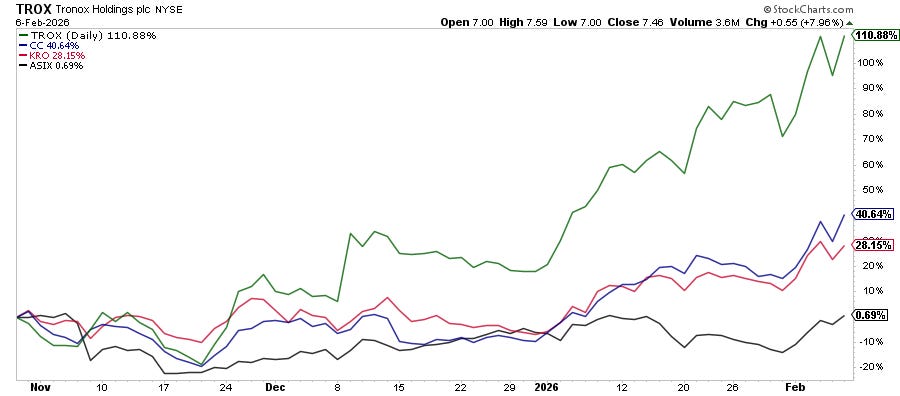
Further gains are likely if the recovery continues. What were potential three- or four-baggers a few months ago can still double or more from their current prices.
For investors seeking to understand the cyclical chemical sector, this article reviews several of my macroeconomic and company-specific investment theses.
A cyclical recovery is likely in the chemicals sector, as each subsector undergoes its own adjustments between supply, demand, and prices. Although the timing of a recovery is uncertain, chemical stock prices had declined to levels that made prospects for doubling in the next two or three years promising.
I published four articles on the chemical sector and why I believe it is undervalued in these three articles:
A Titanium Dioxide Market Recovery Appears Imminent
The Chemical Sector Overview: Olefins And The Rest
Chemical Sector Macro 2: The Current Downturn And Prospects For A Recovery
Chemical Sector Macro 3: Lessons From Past Cycles Applied To Today’s Stocks
Characteristics of the Current Downturn
For much of the chemical industry, the downturn started in 2021. Many companies saw utilization drop below 80%, and margins hover around cash costs. Within the industry, it felt like a recession, even though overall GDP kept growing. Meanwhile, investors who had faced years of losses abandoned the sector and sold their stakes.
This unique circumstance—where the overall economy grew but chemical subsectors were stuck in a cyclical downturn—created an opportunity. Many investors and sell-side analysts were waiting for a recession to hit before purchasing the more cyclical chemical stocks. A recession would lower prices, but it would also speed up the sector’s recovery by forcing a supply adjustment. If, on the other hand, a recession failed to materialize, a strong rally could be in the cards.
The chemical sector’s downturn had three overlapping drivers:
A global capacity buildout. This was most pronounced in olefins.
Weak industrial end markets in key regions. Europe’s high energy costs, restrictive regulations, and shrinking manufacturing base have hurt global chemical demand. Weakness in China’s property and heavy industry. A downturn in North America’s housing and construction markets. These factors all contribute to weak end-user demand.
An abnormally long destocking phase. During the post-Covid supply chain chaos, buyers over-ordered. The resulting inventory excess caused buyers to become more cautious, ordering just enough to manage their bloated inventories. This pattern lasted longer than the typical one or two quarters usually seen in the industry’s inventory cycles. As apparent demand dropped below actual end demand, the weakness in volume and utilization became even more apparent.
These factors led many investors to abandon the entire sector of cyclical chemical stocks. What I believe many overlooked was that, although all stock prices were low, the outlook for individual companies and their stocks was more complex.
For one, downturns and recoveries in the sector occur across distinct value chains, each with its own capital cycle, specific supply-and-demand dynamics, logistical constraints, customer inventory practices, and pricing strategies. As a result, investors who can determine which subsectors or value chains are poised for a recovery can identify high-return candidates.
Next, the sector had to be divided into two groups: value chains that were structurally challenged, and those that were cyclically depressed.
Structurally challenged value chains were parts of the chemical sector where capacity was overbuilt but was politically, strategically, or economically difficult to reverse. The overcapacity keeps prices too low, putting many producers at risk of bankruptcy.
Olefins are the poster child. The subsector saw massive investment from international oil and gas majors in large-scale cracker and polymer units. Overbuilding was most severe in China and North America. Structural overcapacity means that recoveries can be fleeting because new foreign supply keeps arriving once regional prices rise to levels that make imports profitable. Getting a handle on “mid-cycle earnings” for companies stuck in such an environment can be impossible, rendering appraisals of intrinsic value suspect.
I consider companies operating in structurally challenged niches to be uninvestable.
Outside the more structurally challenged subsectors were the areas of potential opportunity. In many cases, the negativity toward structurally challenged sectors led investors to sell across all chemical subsectors, including those that are structurally viable but cyclically depressed.
Cyclically depressed value chains can adjust supply to long-term demand in a way that leads to a sustainable cyclical upturn. These chains experience bankruptcies, production shutdowns, consolidation, and capital starvation, which bring supply into line with reduced demand. The eventual price recovery drives the next upturn.
Given the bargain prices on offer, this subset of chemical names was ripe for long-term investment.
