

We have a lot of ground to cover in this update. Here’s what happened this weekend:
US and Iran failed to reach a peace agreement.
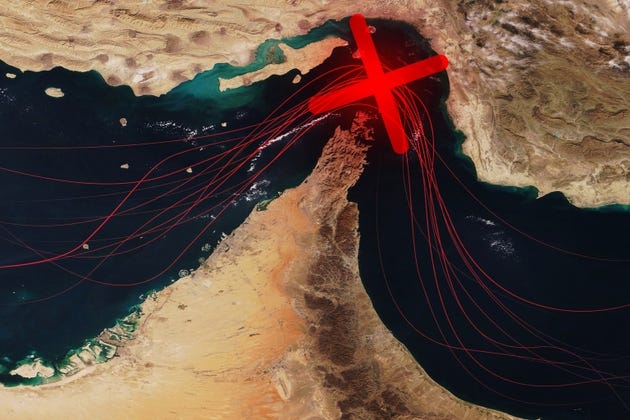
President Trump announced today that the US Navy will form a blockade to prevent Iranian ships from passing through the Strait of Hormuz.
Anyone who reasonably expected Iran and US to reach a peace settlement at a meeting over the weekend must not have studied the previous Nuclear Deal signed into place under President Obama. The Iranians are infamous for being tough negotiators, and with the Strait of Hormuz traffic under their control (for now), they will push this advantage to the end.
As for the negotiation, there were 3 sticking points that will continue to pose as major issues going forward:
The US rejected any notion of a toll fee arrangement from the Iranians and demanded that the Strait of Hormuz be reopened immediately. Again, we have discussed this in depth in this write-up. The notion of a toll fee arrangement is a non-starter for the GCC. Yes, you can have a gradual reopening, which prevents shut-in production from returning, but you cannot have a gradual reopening with a toll fee.
The US demanded that the Iranians hand over or sell their entire stockpile of near-bomb-grade enriched uranium. No agreement on that front.
The Iranians demanded that $27 billion in frozen revenue held abroad be released. In addition, Iran sought reparations for damages.
In my view, the Strait of Hormuz issue will be the biggest sticking point going forward. As I’ve written numerous times, the bogeyman is out; the Iranians have now played their ultimate trump card. To relinquish this advantage is to admit permanent defeat in the future. This is one bridge they will not cross, no matter what.
For the US, the move to blockade traffic in the Strait of Hormuz will be difficult to execute. We have more questions than answers at this point, so let’s dig deeper.
Impact on the Oil Market
On the blockade, here are some questions we have that will need to be answered:
What is the enforcement mechanism if the vessel conveys a different destination? GPS spoofing is common knowledge amongst the shadowfleet tankers. Is the US Navy just going to stop every vessel that’s currently on the sanction list?
Will the blockade cover the Jask terminal, where Iranians can divert crude oil production from Kharg Island? If so, how will the US Navy respond to ground forces launching missiles and drones at the ships?
Will the US Navy get into a confrontation with Chinese vessels? If so, what are the ramifications there?
For the oil market, here are some of the facts:
Iran currently has ~170 million bbls in floating storage/oil-in-transit. Despite the US lifting sanctions on Iranian exports, Iran has been slowly depleting this stockpile. At $135 per barrel (physical market prices), Iran’s floating storage is worth $22.95 billion. This will buy it some time to deal with the blockade (assuming it’s effective).
The US blockade, if effective, would choke off Iran’s crude export, which is estimated to be ~1.6 to ~2 million b/d. This would increase the global oil supply outage to 12.6-13 million b/d.
Another important ramification for the global oil market is that the Bab el-Mandeb Strait, which is responsible for Saudi’s entire crude export volume from Yanbu today (4.5 to 5 million b/d), could be disrupted by the Houthis. If this chokepoint develops, global supply would be out by 17 to 18 million b/d.
At this point, the oil math is impossible to fathom. The scale of the supply disruption is the equivalent of the demand disruption we saw at the peak of COVID. To balance the global oil market, prices will need to reach a level that matches the level of activity reduction we saw in 2020.
At some point over the coming weeks, countries with insufficient storage capacity will have to impose the same degree of lockdowns. This is when the physical oil market will escape reality and enter into fantasy land.
I suspect in the coming weeks, sellside analysts will have to start asking the question: how high do oil prices have to go to balance ~13 million b/d of supply disruption?
Note: Please read our article: Oil Demand Destruction Is Coming, It’s Too Little Too Late.
It’s anyone’s guess now, but I can tell you this with confidence: it’s not $150/bbl, it will have to be a lot higher.