

WTI and Brent, as of this writing, are down ~14%. The US and Iran agreed to a 2-week ceasefire pending “safe passage” through the Strait of Hormuz. Ahead of the Friday talks, these are the 10 points Iran has presented to the US:
Commitment to non-aggression.
Continuation of Iran’s control over the Strait of Hormuz.
Acceptance of uranium enrichment.
Lifting of all primary sanctions.
Lifting of all secondary sanctions.
Termination of all UN Security Council resolutions.
Termination of all Board of Governors resolutions.
Payment of compensation to Iran.
Withdrawal of U.S. combat forces from the region.
Cessation of war on all fronts, including against Hezbollah in Lebanon.
Over the next few days, I’m certain you will read a lot of takes on whether the US will actually agree to any of these points, but from my perspective, I will just offer you my analysis on the energy-related side of things.
On the Strait of Hormuz front, Iran’s Foreign Minister, Seyed Abbas Araghchi, wrote on X (related to the Strait):
For a period of two weeks, safe passage through the Strait of Hormuz will be possible via coordination with Iran’s Armed Forces and with due consideration of technical limitations.
With that, let’s get started.
Implications on Oil
There are currently ~180 million bbls of stranded floating storage in the Persian Gulf. This temporary ceasefire unlocks these barrels. The short-term impact, oil selling off, is in part related to these barrels becoming available on the physical market.
Now there are still more questions than answers. For starters, will Iran charge a toll fee? If so, how much?
We don’t know the answer to that, but let’s assume some producers accept this toll arrangement. Iraq needs the tankers offloaded, as it is the most severely affected by the current Strait closure. But even though tankers are able to exit the Strait of Hormuz, you need empty tankers to travel in to load additional crude.
In addition, the empty tankers will have to first drain the onshore storage built up before producers can restart production. For Iraq, 2-weeks is far from adequate to restart production. There are also no guarantees that the Strait will remain open after 2-weeks. Given that Iraq sells on a free on board (FOB) basis, where the buyer assumes all transportation, insurance, and freight risks once the crude is loaded on the tanker, I don’t think anyone will take the risk of being stuck in the Strait again.
In essence, the ceasefire does not change the production shut-in math. The current production shut-in of ~11 million b/d will continue.
On the toll arrangement front, if Iran implements a toll fee arrangement, I fear we have not yet seen the worst for the global oil market. As we explained in this WCTW piece titled, “The Unacceptable Status Quo And Why The Oil Market Will Never Be The Same Again.” The Saudis will never accept the toll fee arrangement.
Both the Saudis and the UAE would rather divert crude exports via the East-to-West and Abu Dhabi pipelines than pay a toll to Iran. This is primarily due to the power dynamics of controlling your own destiny (crude production/export). If Iran is allowed to impose a toll fee, it will effectively have a say in future exports out of the Gulf. That’s a non-starter for the Saudis and UAE. This is an existential crisis, so it would rather keep production shut-in than play the game.
The Math
Because the ceasefire doesn’t change the production shut-in figures, total barrels lost will remain the same through this 2-week stretch.
Even if we assume that ~180 million bbls are unlocked, it buys the world an additional 16 days. But the timing mismatch will be problematic. Even if all the tankers make it out tomorrow, it will take 30-45 days to reach their destination and discharge. India benefits here, given the close proximity to the Strait, but countries like China, which will absorb all the excess for SPR, will have to wait closer to 45 days.
OECD commercial crude oil inventories have a cushion of ~178 million bbls. SPR release rate in April will total ~75 million bbls (253 million bbls). Given that the production shut-in math for April points to ~330 million bbls, the breaking point for the oil market is already too little too late.
If we assume that the two sides reach a permanent ceasefire agreement in 2 weeks, total oil inventories lost due to the closure will be around 1.2 billion bbls. We will have exhausted the OECD operational cushion for crude by the end of April, and the reality is that we will be facing a physical crude shortage.
Here’s the math we explained in our WCTW write-up yesterday titled, “All Roads Lead To Structurally Higher Oil Prices.”
Let’s use the April 30 ceasefire as an example:
Crude oil production shut-in volumes lost total ~600 million bbls between March and April.
Tanker traffic flow resumes. Tankers stuck in the Persian Gulf start to leave to discharge oil. This will take 35-45 days.
Tankers that received the green light to return to the Persian Gulf have begun transiting. This will take another 35-45 days from travel time to loading.
In the meantime, production shut-in continues. That’s another 30 days, at minimum, or another ~330 million bbls.
Once the tankers arrive to load crude, onshore oil inventories must be drained first; this will take 7-10 days before production can restart. That’s another 70 million bbls.
That puts the production loss total AFTER the Strait reopens at ~400 million bbls.
Production restart will take a few weeks to get back to normal. Assuming that production is operated at half capacity, that’s an additional ~120 to ~140 million bbls of outage. That puts the total now at ~520 to ~540 million bbls AFTER the Strait is open.
Total production outage, even with the Strait of Hormuz opening by April 30, is 1.12 to 1.14 billion bbls, and that assumes no product outage. We are just assuming here that the product outage is offset by demand loss elsewhere.
So why will oil prices remain structurally higher?
As I explained above, the OECD commercial crude oil inventory has an operational capacity of 178 million bbls. Total SPR release is 400 million bbls. That puts the total available capacity at 578 million bbls. IEA will need to release an additional ~700 million bbls to offset the scenario we outlined above.
Given that SPR also has a minimum stock requirement, effective spare capacity is around ~800 million bbls. In essence, if we completely drain the global SPR, we will simply offset the production loss if the Strait of Hormuz returns to normal by the end of April.
So yes, this ceasefire doesn’t change anything.
Problematic
For the oil market, we can jawbone financial oil prices a while longer. US commercial crude inventories are the last to decline. US inventories, as we explained yesterday, will be insulated, unlike those in other regions of the world. But as onshore inventories start to decline now, US crude imports will drop, while US crude exports will spike.
Here’s an illustration of the current tanker flows headed for the US by the first week of May, irrespective of what happens to the Strait of Hormuz:
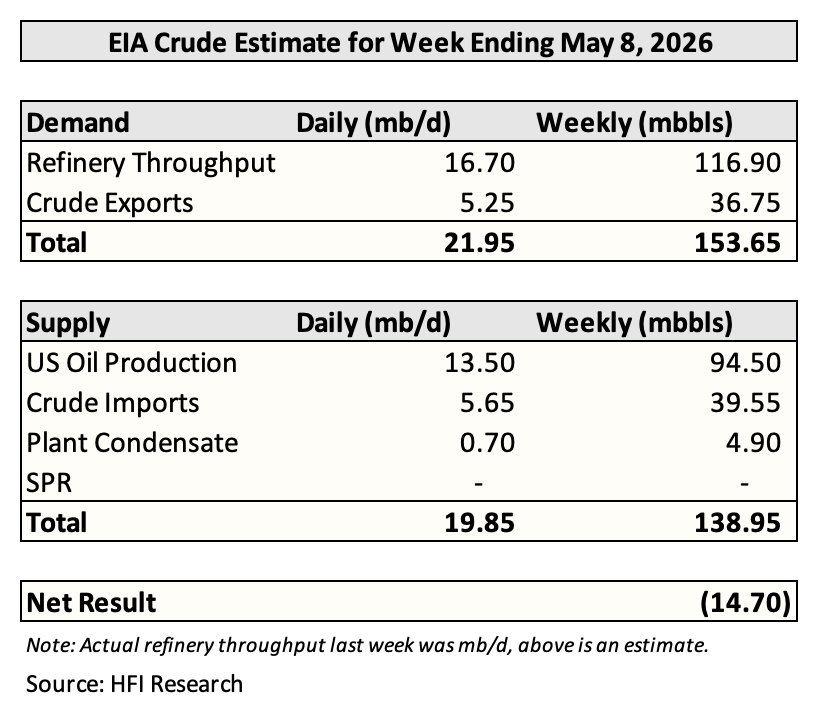
At some point, the cushion in US commercial crude storage, ~80 million bbls, will also give way to a shortage. US SPR release will help dampen some of the incoming draws, but we are really just transferring the SPR release to other regions of the world.
The crude shortage will first translate into lower refining margins and then negative refining margins. Demand destruction is the only way to balance the shortages we will see.
Conclusion
I hope this article was helpful in explaining the nuances of the ceasefire on the oil market. The logistical jam will prevent production shut-in from returning. Meanwhile, the Persian Gulf will first require many tankers to drain onshore storage, and only when there’s a steady flow of tankers will production shut-in return. You can’t just start production and shut-in production a week later. That’s not how any of this works (physically).
Meanwhile, the current crude shortages will eat into the last remaining OECD onshore crude inventories. Once US oil inventories start to show meaningful draws, I suspect that’s when the tipping point for oil prices comes.
Analyst’s Disclosure: I/we have a beneficial long position in the shares of USO, UCO either through stock ownership, options, or other derivatives.
Great piece, thanks. Other questions that we’ll have to wait to find out the answers to are: 1) how many ship captains will be happy to run the gauntlet 2) how many countries will refuse to pay the toll for fear of setting a precedent 3) what do the insurers think about a ceasefire agreed late at night by social media exchange 4) how many ships will Iran let through a day given they are incentivised to keep oil prices high and the pressure on the global economy up 5) how many captains will want to come back after being held hostage for over a month based on a flimsy ceasefire that may break at any minute 6) how will Israel behave in Lebanon specifically and the Gulf more generally given it wants the war to continue 7) what does MBS do especially after Trump’s 'Kiss my ass comment'?
When you say 'structurally higher', what range are you referring to in the next 2 weeks + long term? Are you still in the same positions you disclosed a couple weeks back (~$200 range call spreads and I think May calls at $150ish on USO)?