

Editor’s Note: This article was first published to paying subscribers on August 10. Please also check out today’s WCTW, “How Much Time Do We Have Left On The Oil Math?”
Geopolitically speaking, what happens in the next few weeks will have important ramifications for the oil market for years to come.
In last week’s WCTW titled, “The Importance Of Fujairah And Why It Is An Inevitable Escalation Point For The Global Oil Market.” I explained that the scenario President Trump is pursuing is the following:
Scenario 3: Talks are ongoing, small strikes back and forth, and Trump is just trying to survive the midterms
This scenario is what’s currently unfolding. The US is using these 1 to 2 week strikes to temporarily knock out Iranian capabilities so it can conduct S2S to help buffer the global oil math. In the meantime, Trump is using his market moving powers to flush oil prices down using the same strategy of war on, war off, peace on, peace off.
So far, this strategy is working and it’s possible they can keep doing this dance until the midterms.
But for the Iranians, they also know that this is the playbook, which brings in the Fujairah card as an inevitability. If Iran does not play the Fujairah card during this window (August), then it will have lost leverage on the midterms and the oil math. Every day that goes by without enforcement in the Oman lane implies that Iran is losing leverage.
Logically, this means that Fujairah is next, which would pressure the global oil market like we’ve never seen before.
Over the weekend, Axios reported that Trump is trying to “low-key” the Iran conflict and let economic pain do its damage on Iran. From the US’s perspective, time is on its side.
Well, if you look at where WTI is trading today ($82), you would have to agree. The oil market today is in the twilight zone, and oil market participants have become Pavlov’s dog. Every time a bearish headline comes out, the price drop outweighs any escalation price rally.
Scott Bessent, the US Treasury Secretary, really worked his magic. Kudos for the best manipulation job on the planet.
And for those who are still in denial that the US is not manipulating the oil market, all you have to do is look at the headlines last week. Scott Bessent himself appeared on TV last Tuesday and said the Strait of Hormuz would reopen within hours or by Wednesday.
Well, is the Strait open?
It’s not open, and I suspect things are about to get a lot worse.
Iranian Demands
Over the weekend, a few things became apparent to me.
Diplomats have completely lost power/influence in Iran. The Supreme National Security Council, the group that needs to approve the Oman/Iran deal, set forth demands that the US needed to meet before the Strait of Hormuz would reopen:
Never threaten Iran in any language, nor insult the sanctities of this nation.
Permanently end the war and aggression against Iran and its allies in Lebanon, Palestine, Yemen, and Iraq.
Lift the naval blockade and withdraw its military forces (naval and air) from around Iran.
Pay full compensation, without deduction, for the damages of the two aggressive and imposed wars against Iran.
Lift the cruel and illegal sanctions against the Iranian nation.
Unconditionally release the frozen and stolen assets of the Iranian people.
For those of you keeping track, the addition of Palestine, Yemen, and Iraq on the list is new. Previously, MOU 1.0 only contained Lebanon, so the new additions imply a total surrender by both the US and Israel, red lines for both states.
In addition, Iran is now demanding full compensation for the damage it suffered before reopening the Strait of Hormuz. This was not in MOU 1.0.
These conditions are equivalent to a total surrender by the US, meaning there is no face-saving exit for Trump.
As I have said from the start, with each passing day without a resolution, the probability of a resolution decreases. In June, I wrote that the odds of a diplomatic resolution were zero; now they are negative.
The issue of the Strait of Hormuz has no diplomatic resolution. There’s no way out but through. Trump can either realize that now or face the inevitable escalation down the road. One way or another, we will find out soon enough.
The Game The US Is Trying To Play
Now that we know what the Iranians want, we also know the game Trump is trying to play. After successfully training oil market participants to become Pavlov’s dog (stay biased on the bear side), the US seems to think that the Oman lane transit (4-6 million b/d), coupled with more SPR release down the road, could save them by the midterms (3 months away).
It appears the Trump administration thinks that if it can leak possible peace deal headlines every now and then, it can suppress volatility in the oil market enough to keep participants from buying long positions. Couple this with suppression algo trading observed daily (9 PM EST and 3 AM EST), they think they can keep oil prices low enough and long enough to re-escalate after the midterms.
Now from a physical oil market standpoint, it doesn’t really matter if their logic is right or not. Remember that the oil market is not exactly transparent when it comes to data. The most visible oil inventory data is in the US, and satellite onshore crude inventory data providers are not exactly precise. As a result, most oil traders rely on “price” as the signal, so if the signal is distorted in anyway (intervention), it makes it nearly impossible to assess the true deficit of the market.
In that regard, can the Trump administration keep playing this game for another 3 months?
Yes, I think they can. They’ve trained market participants enough to stay away from going overly bullish on crude. The end result is that traders are hiding in products, timespreads, and options. None of these things will drive the underlying crude price higher.
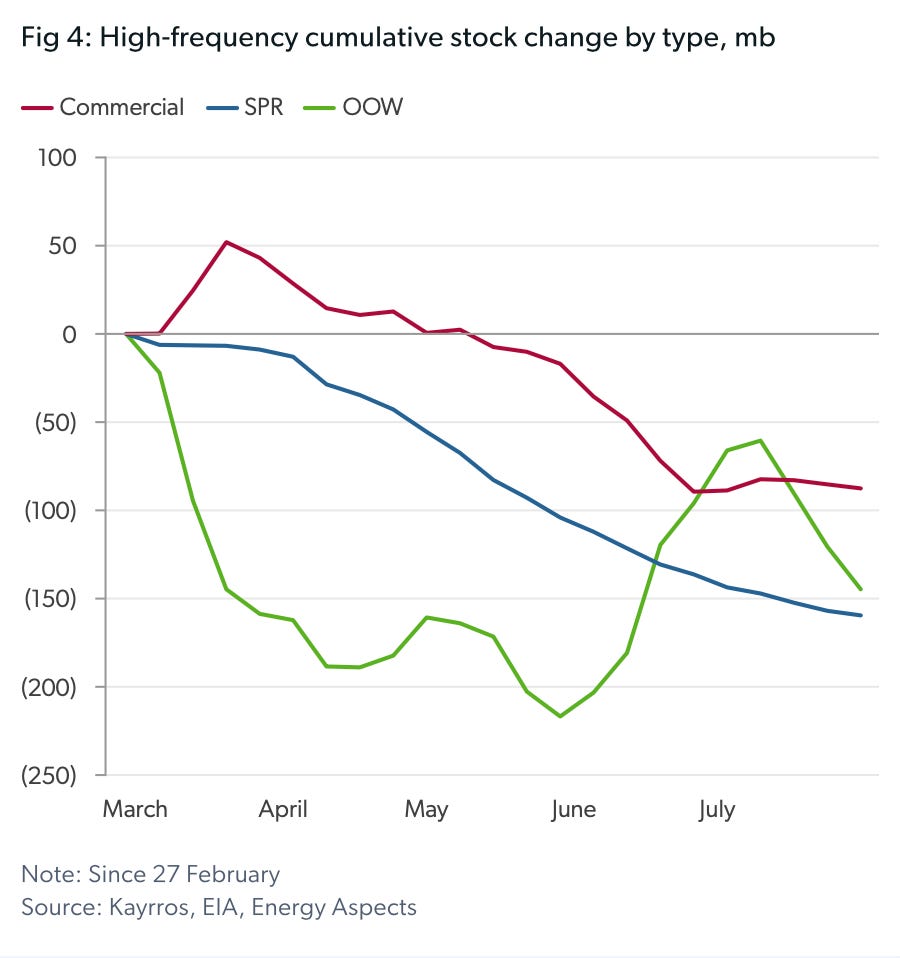
And despite the world seeing the largest crude inventory draw in history, Brent is at $87.
So this is the game Trump is trying to play, but I don’t think Iran will let him.
Turning Point
Since the start of the war, Iran took the stance of retaliating only when the US attacked. It was tit-for-tat, but it required US escalation first.
I think the tide has turned.
Over the past week, Iran has attacked 1 vessel daily that transited the Oman lane. Some days have been successful (like this weekend), some days have not.
Despite the ongoing attacks, the US has continued the tanker escorts, which implies that the escalation is not enough to deter the behavior. As a result, I believe we have approached the turning point.
Iran now needs to escalate to the point that the US is either forced to retaliate or they have to surrender. Logically speaking, they won’t let Trump “low key” the conflict until the midterms. The very survival of the Iranian regime is dependent on what unfolds in the coming weeks, and all the signs point to escalation.
In last week’s WCTW, I explained my logic for why Fujairah is an inevitable escalation point. At the moment, the Trump administration is relying solely on the ship-to-ship transfers to get the oil market by. One US official even bragged to Axios this weekend that there’s ~8 million b/d of crude going through the Oman lane.
This is why I think from an oil market standpoint, if Iran doesn’t speed up the escalation, then it will give Trump the breathing room he needs to survive the midterms. Again, logically speaking, I think the turning point is now.
Long-Term
Why does how this develops reshape the oil market for years to come?
Well, if you think this through logically, and Iran escalates. The US will either have to totally capitulate or escalate.
If you assume that the US capitulates, then Iran will dominate the Strait of Hormuz and limit any inbound tankers to countries hosting US military bases. That includes Saudi, UAE, and Kuwait. This is 9 million b/d.
In such a scenario, oil prices will be extremely elevated.
Now if you assume that the US doesn’t capitulate and instead escalates, then the escalation trap points to energy infrastructure being hit down the road, which will again keep oil prices elevated for years to come.
Right now, the consensus continues to see the Strait of Hormuz issue as a transitory event. It could not be further from the truth. The escalation turning point we are about to witness will have ripple effects on the oil market for years to come.
The consensus is wrong to see this as a transitory event. This is the turning point a lot of people are going to miss.
Conclusion
The oil market will never be the same again. Iranian demands make it essentially impossible for there to be a diplomatic resolution. With that, the US faces the inevitable choice of total capitulation or escalation. Both scenarios result in higher oil prices for longer contrary to consensus expectations.
What we are going to witness in the next few weeks is the turning point for the global oil market.
Analyst’s Disclosure: I/we have a beneficial long position in the shares of USO, UCO, BNO either through stock ownership, options, or other derivatives.
Except for a few stray others (Tracy Suchart, Gorozen.com, and others, it's us against the world on higher for longer and sooner, oil prices. When do we get vindicated. Also, I that read the diesel crack spread is $100/bbl. Something has to give. maybe 3q AI fantastical price drop and rotation?